
Ziyi Wang
she/her


I am a UX designer with a background in graphic design. Through research, critical thinking and a systems perspective, I create inclusive experiences that solve real problems and deliver lasting value.
she/her

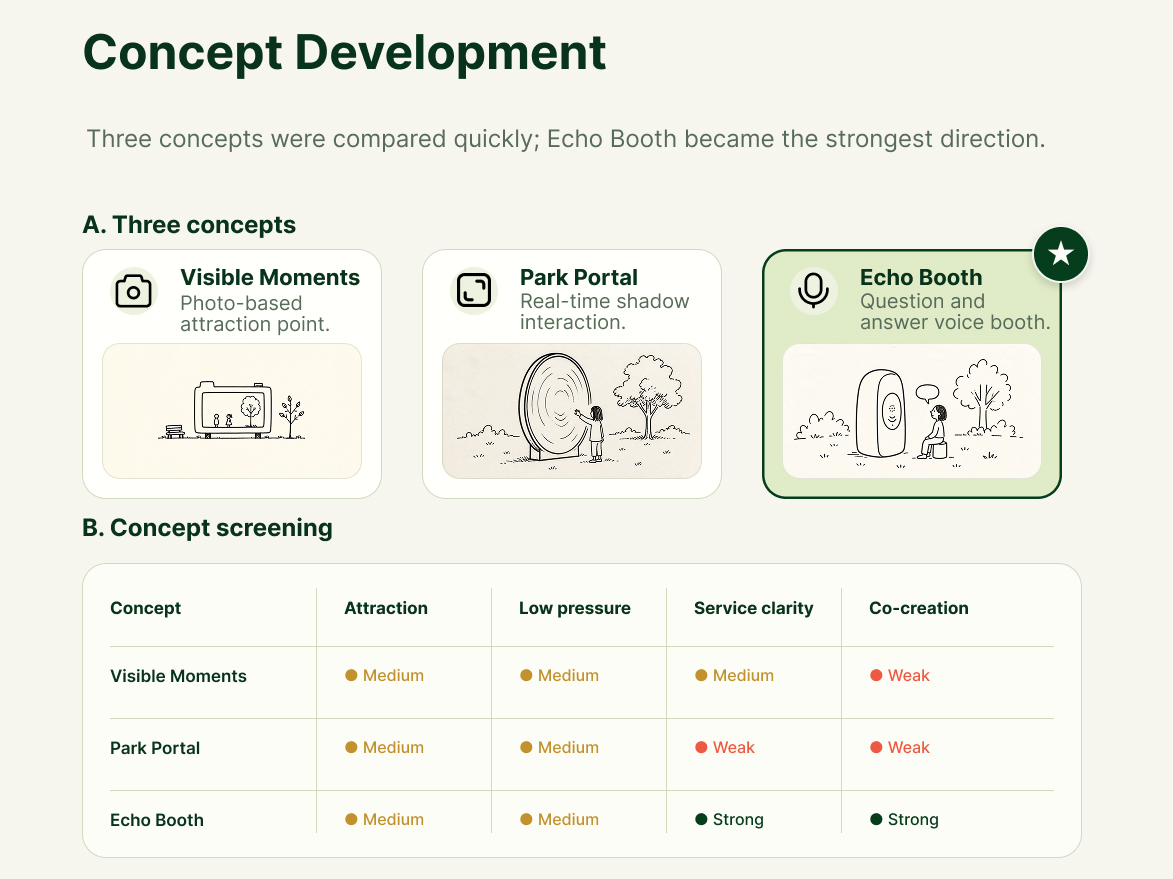
Echo is an intergenerational voice experience designed for urban parks. Through anonymous, asynchronous voice exchange, people of different ages can listen to one another’s experiences, respond to questions and connect without the pressure of a face-to-face conversation.
Through its outdoor interactive wall and indoor voice booths, Echo allows a brief encounter in the park to continue over time. As voices accumulate, perspectives and everyday experiences from different generations are preserved, gradually forming a shared community memory.
The problem is not only ageing or loneliness; the everyday social conditions that allow different generations to meet naturally, recognise each other, and understand one another are disappearing.


Future communities will support natural, low-pressure, repeatable intergenerational encounters, enabling people of different ages to continue being seen, stay connected, and become part of everyday community life.
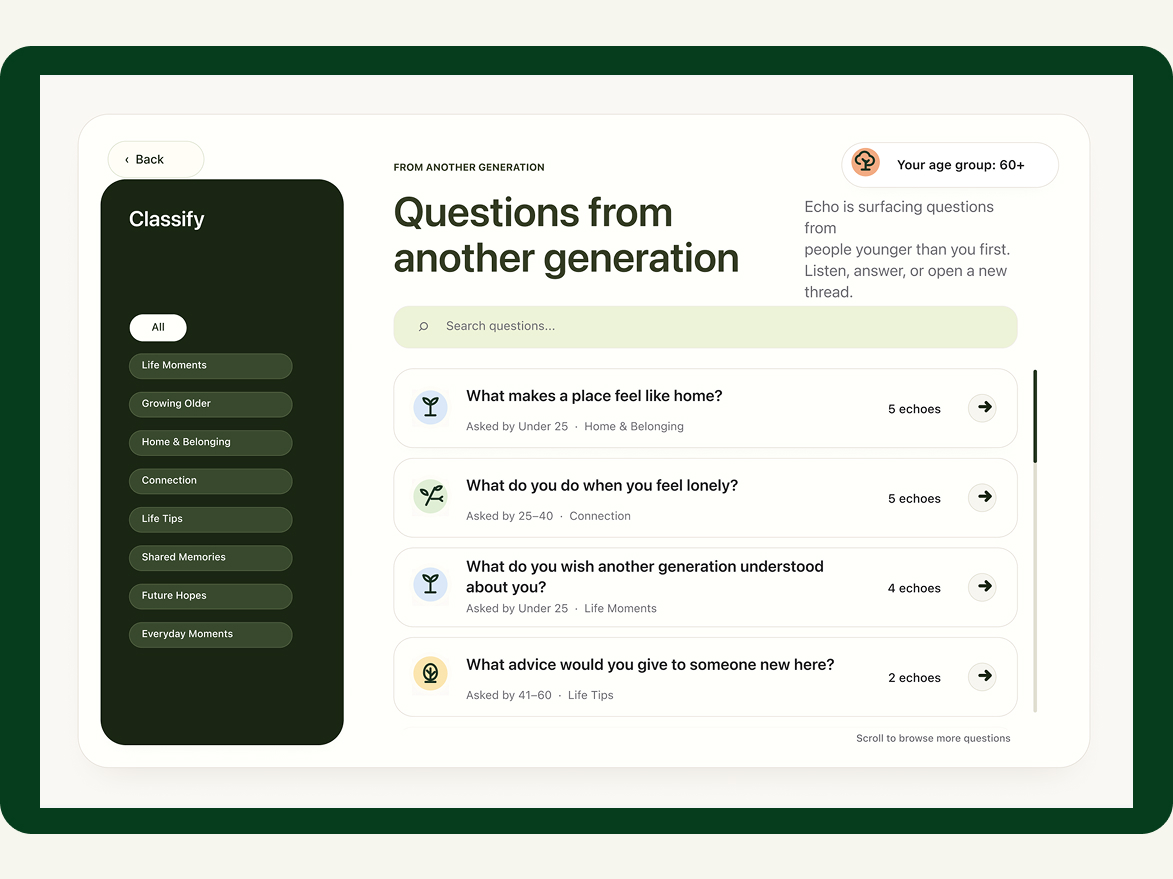
Users first encounter Echo’s outdoor interactive screen. Floating “Echo submitted” messages spark their curiosity and invite them inside. There, they can listen to questions from different age groups, record a response, or leave a new question for another generation. After submitting, they can return later to check for replies, allowing a brief encounter to continue across time.

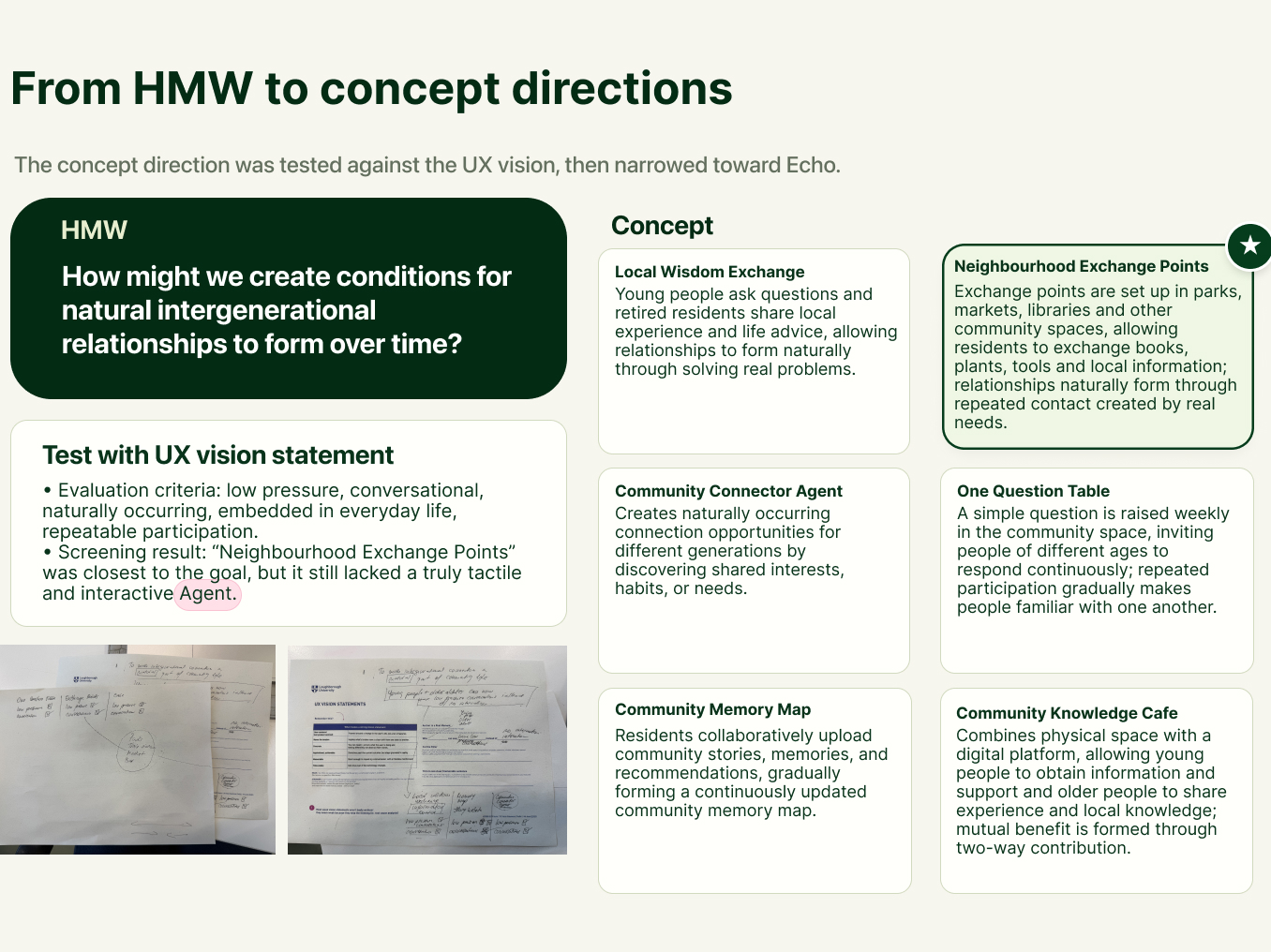
Research from the Generative module identified four design opportunities: repeatable, low-pressure, socially visible and equal intergenerational participation.
Existing intergenerational designs often rely on one-way assistance or transactional exchange. Echo instead enables different generations to co-create content and community memory, forming a more equal and reciprocal relationship. This became its “WOW” value.


I conducted scenario walkthroughs and semi-structured interviews with younger and older participants. The findings led to search features, age-only identification, shorter recordings and simpler interface feedback.


After leaving a question, users do not receive an immediate answer. They leave, wait and return later to see whether someone has responded.
This waiting gives Echo longevity. Unlike many digital products that pursue instant gratification, Echo makes time itself part of the interaction and encourages more intentional participation.
Echo uses voice to represent a person’s presence. It protects identity and privacy while preserving a human trace.
A voice can remain anonymous while still conveying emotion, a sense of age and personality. This allows Echo to support intergenerational communication without creating pressure through identity exposure.

Echo has long-term value. Even after someone has moved away or passed away, the voice they left behind can still be heard by family, friends and members of the community.
Echo can also connect the same person across time. Someone may answer the same question differently at 20, 40 and 60. Echo therefore connects not only different generations in the present, but also people with their past selves, revealing its potential for temporal value and collective memory.
At the beginning of this degree, I often wanted to find the “right answer” as quickly as possible, and I doubted my judgement whenever the direction felt unclear. Over time, I learned that design is not about knowing the answer immediately. It is about entering real contexts, listening carefully and gradually finding direction through uncertainty.
Research is no longer simply a step used to prove an idea. It helps me uncover overlooked needs, understand the reasons behind people’s behaviour and ground each design decision in evidence. This experience has also deepened my understanding of behaviour change and how design can influence the way people think, feel and act. It gives my work direction and helps me explain clearly why a particular decision was made.
I aim to become a research-driven and human-centred UX designer. For me, design is not only about creating clear and usable interfaces, but also about understanding the needs, barriers and emotions people experience in real life.
I am especially interested in older adults and people whose needs are often overlooked or underserved by mainstream design. Through inclusive and accessible design, I want to reduce barriers to participation, enabling people of different ages, abilities and backgrounds to use products and services independently while feeling seen, respected and valued. Throughout my professional journey, I hope to strengthen my ability to turn this commitment into practice and create impactful solutions for real-world business and social challenges.