A Product Designer with a cross-disciplinary background in biology and illustration, specialising in healthcare and creative products. Adept at navigating wicked problems. Dedicated to crafting meaningful, transformative designs for people and society.
HERloom – Heirloom of Women’s Bodily Experiences
This is a gynaecological care service designed for Taiwanese women of all ages, helping them articulate, share, and find resonance with gynaecological experiences across the life course. Anonymity and creative expression create a foundation of psychological safety. Within this supportive community, women at different life stages gain expressive and bodily agency, companionship and validation by having their lived experiences seen, heard, and passed down to future generations — girls and boys alike.
Definition of user outcomes:
Expressive agency: able to name or give shape to their feelings
Bodily agency: navigating bodily changes with confidence
Companionship: feeling accompanied through distressing moments
Validation: feeling their experience matters and can help others
00 Background
About me
Cultivated through my biology education, I have always been passionate about human wellbeing. When exploring gaps in the healthcare domain, I was struck by how women’s health has been under-researched for decades, and meanwhile, medical misogyny and cultural stigma continue to compromise women’s healthcare experiences. I felt an urgent need to address the pain gap; not as a temporary fix this time, but with the ambition of driving long-term societal progress. I am delighted that this project allows me to bring together my scientific and design expertise to create meaningful change in women’s healthcare.
The challenge: barrier of a reserved culture
In Taiwan, gynaecological health beyond menstruation is rarely discussed openly, with topics such as menopause and sexual health still carrying stigma. Half the population endure confusing or painful experiences in silence, perpetuating and widening the pain gap.
Diving deeper, the problem begins with fragmented education in schools and families. Gynaecological health is often reduced to menstruation without broader life-course topics, and is not openly taught to boys or girls, leading to indifference, especially in partner relationships and the workplace as well as stigmatising attitudes in public discourse. Meanwhile, recent policy debates around contraceptive access raise growing concerns about women’s bodily agency. All of this underscores the urgency of addressing the problem in Taiwan.
01 Research Through Design
Data collection I
To begin with, I captured the problem space through secondary research (digital ethnography, journal articles, grey literature), with insights informing the materials and methods of generative research sessions designed to uncover tacit knowledge. Participants of all genders were welcome to join. These methods allowed participants to elaborate on abstract emotions and values, and to make sense of their preferred futures.
Data collection II
Expert interviews and surveystudy were conducted alongside to support objectivity and inclusivity. Expert interviews captured perspectives from gynaecological doctors and school teachers. An anonymous survey (44 valid responses) offered a more comfortable option for women who preferred not to share sensitive experiences face to face.
Data analysis
Thematic analysis was conducted to interpret qualitative data, and participant boards were used to identify women’s unspoken needs. Ecosystem mapping pinpointed the systemic gap for design intervention. These insights informed design assumptions and guided concept development.
Insights
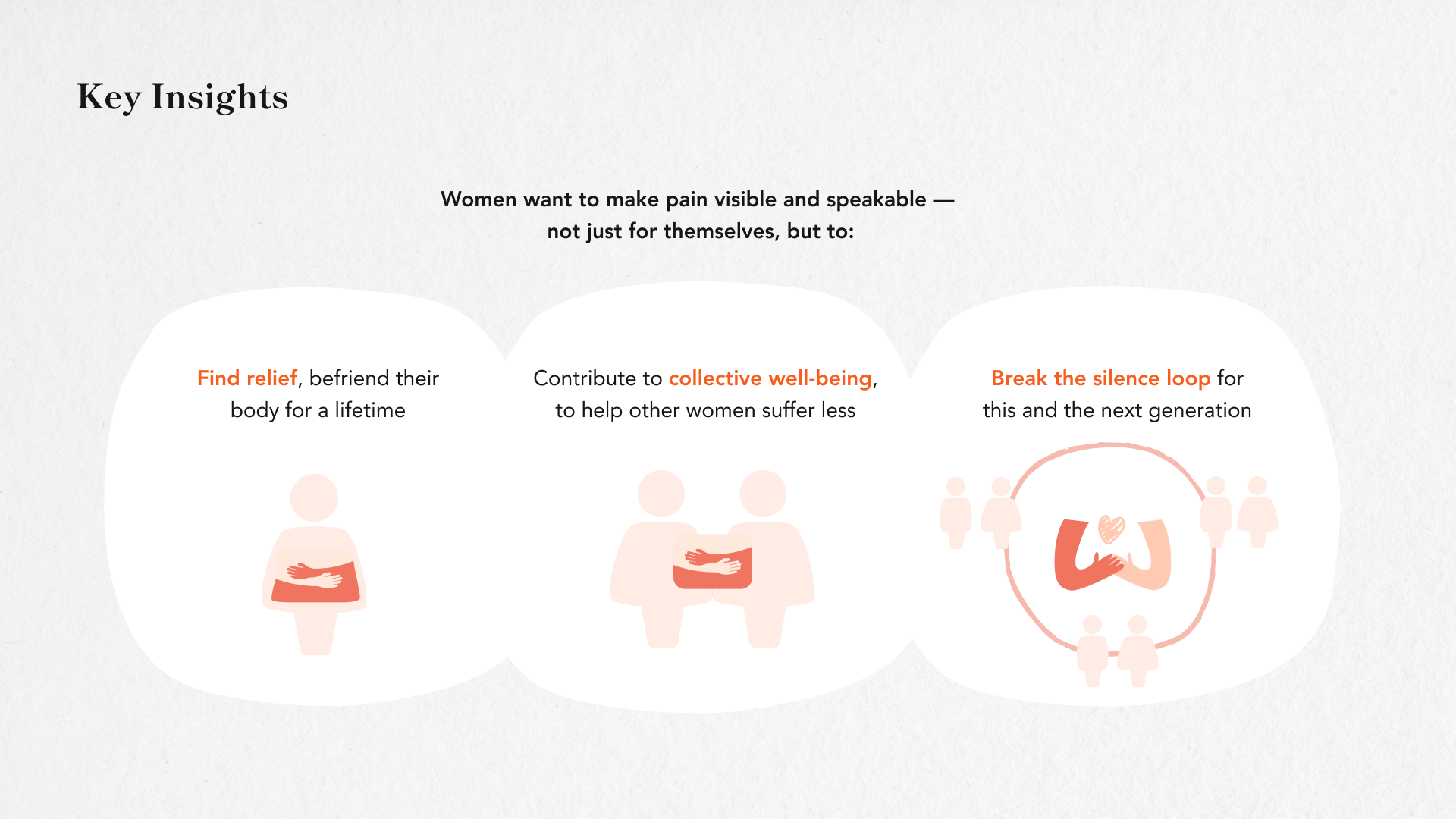
The silence is reluctant. Women want to speak up to break societal reticence. Beyond personal healthcare, they value collective wellbeing: they dream of living in an environment where bodily experiences can be shared openly, met with understanding, and transformed into greater empathy from those around them and from society at large.
UX vision statement & Design principles
The lack of women’s own language and space for gynaecological experiences is the core problem — not only are pain, discomfort, and emotions often too abstract to articulate in words, but we have never been taught how to discuss them. The design principles of visibility, life-course support and normalisation help ensure that the solutions relieve women’s suffering in the present while driving long-term societal impact, including shame removal and destigmatisation. Visibility makes both pain and the issue seen. Life-course support provides experiential and emotional care. Normalisation opens the conversation.
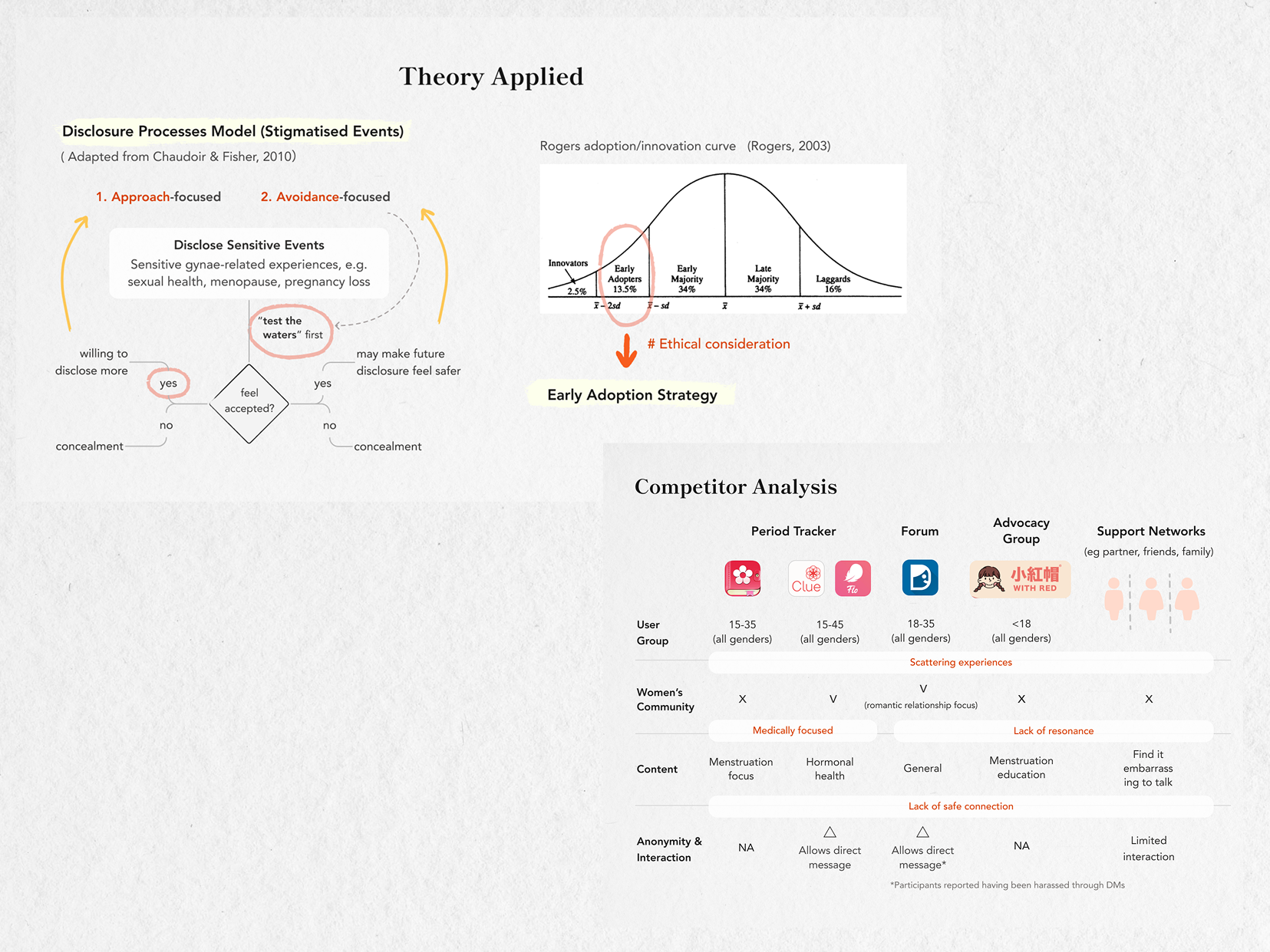
Theories: the disclosure processes model and early adoption strategy were applied in response to the reserved culture. These helped define the user roles in the service: contributors and receivers. They share the same pain points and user outcomes, but differ in their level of psychological safety and motivation for disclosure. Their roles may shift as psychological safety grows, i.e., passive information receivers may start acting as proactive experience contributors.
Competitor analysis highlighted that innovation opportunities should include a life-course approach, centring women’s subjective feelings, intergenerational care, and psychological safety. Existing solutions are medically focused, offer scattered health literacy, and carry safety risks such as harassment.
Co-design: Pain expression
I did not directly go with women-helping-women in the first stage, instead, I tried risker paths.
I worked with young women (n=4) in the first stage, aiming to understand what best helps them express pain, and how they want others to respond.
I provided provocations and set up scenes for participants to vividly interact with partners, friends, the workplace, and young girls and boys. The expression material was clay, which offers shaping flexibility and enables creativity. Thematic analysis was performed after four sessions.
As the key insight suggested that target users want the support from daily relationships, i.e., friends and partners, I narrowed down the problem scope to intimate circles.
Brainstorming initial concept
Frantic fives and brainwriting helped quickly generate raw ideas. How, Now, Wow was used to prioritise the most promising solutions. Risk assessment helped identify high-risk, uncertain assumptions to test early.
The initial design concept was Empathy Dictionary: building a shared language of pain and caring. It starts from intimate circles where women are more willing to share their gynaecological experiences, and support networks learn to respond in their caring language. Over time, it may become a safer place for other intimate circles to talk; as this generation grows older, the language and experiences accumulate, which can help open up the conversation for the next generation.
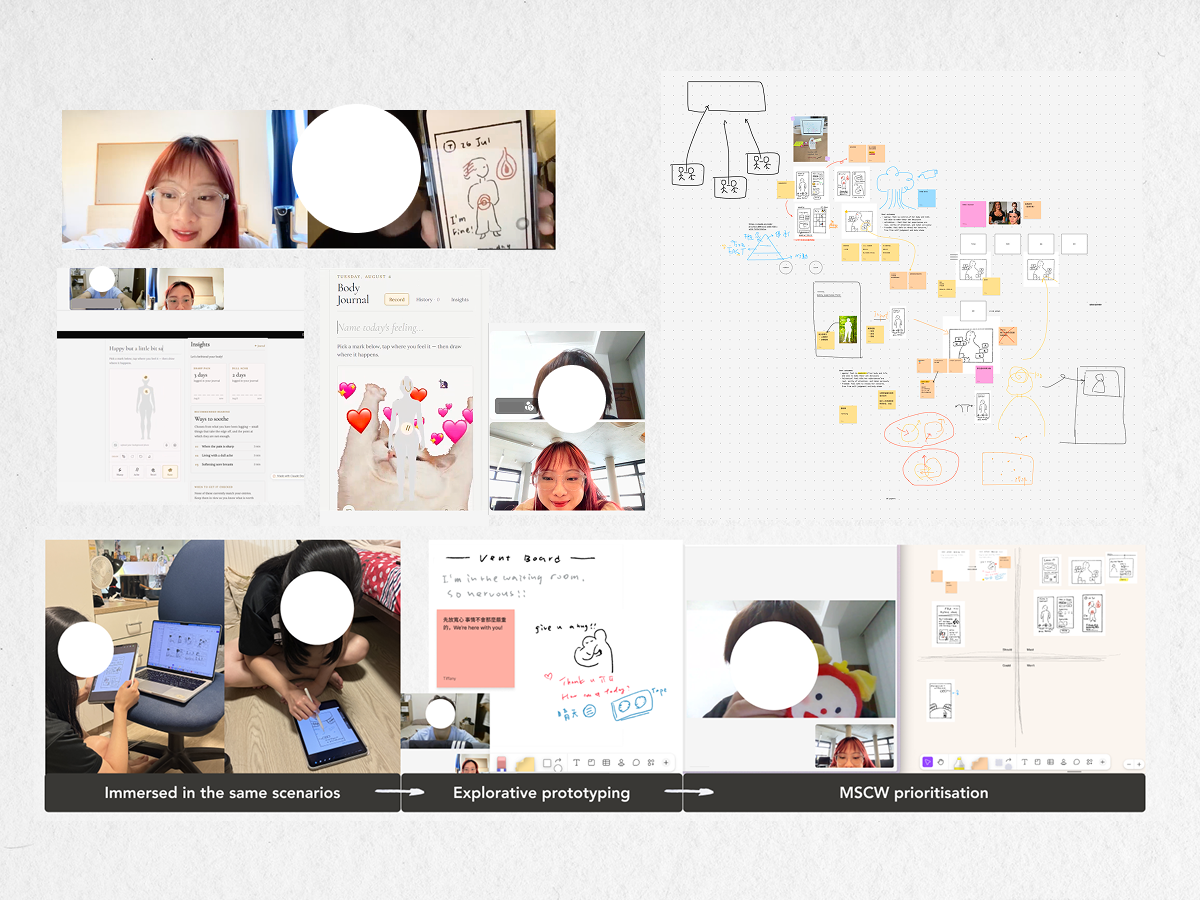
The purpose of the three sessions differed: the first tested whether the user journey was reasonable and conversations could open naturally, the second explored engaging community features, and the third strengthened the concept of shared language building. Both in-person and remote participants went through the same scenarios and user flow; the only difference was the gynaecological conditions they might face in the storyline. We interacted with each feature (known as explorative prototyping) as the storyline reached the relevant point. The same set of questions came at the end of each session, followed by MoSCoW prioritisation, which helped identify which features and core experience elements achieved the best user outcomes.
Participants included women aged 25-60 (n=15) and men aged 30 (n=2).
Major iterations
Alongside experience prototyping, I conducted expert evaluation with a UX designer in the healthcare industry to improve the feasibility of the product. Based on feedback from users, my supervisor, and the expert, I iterated the design as follows:
1. Due to ethical considerations, I set aside medical-related design and male user groups, as Taiwanese law does not permit the former, and the design direction risked evoking unresolved trauma between couples. I pivoted the concept from health awareness enhancement (and partner dynamics) to a community of women helping women.
2. Enabled a self-evolving language system. Initially I made the mistake of over-defining the language system, as some participants reported feeling frozen by a blank canvas. However, a quick vibe-coded prototype proved that expression enablers were the ideal provocation to spark creation.
3. Shifted from “intimate circle” to a “community-driven, intergenerational care” direction, as participants reported: “I want to contribute to a bigger community directly so that not just my friends are informed.”
– Stage III: Finalising the design concept –
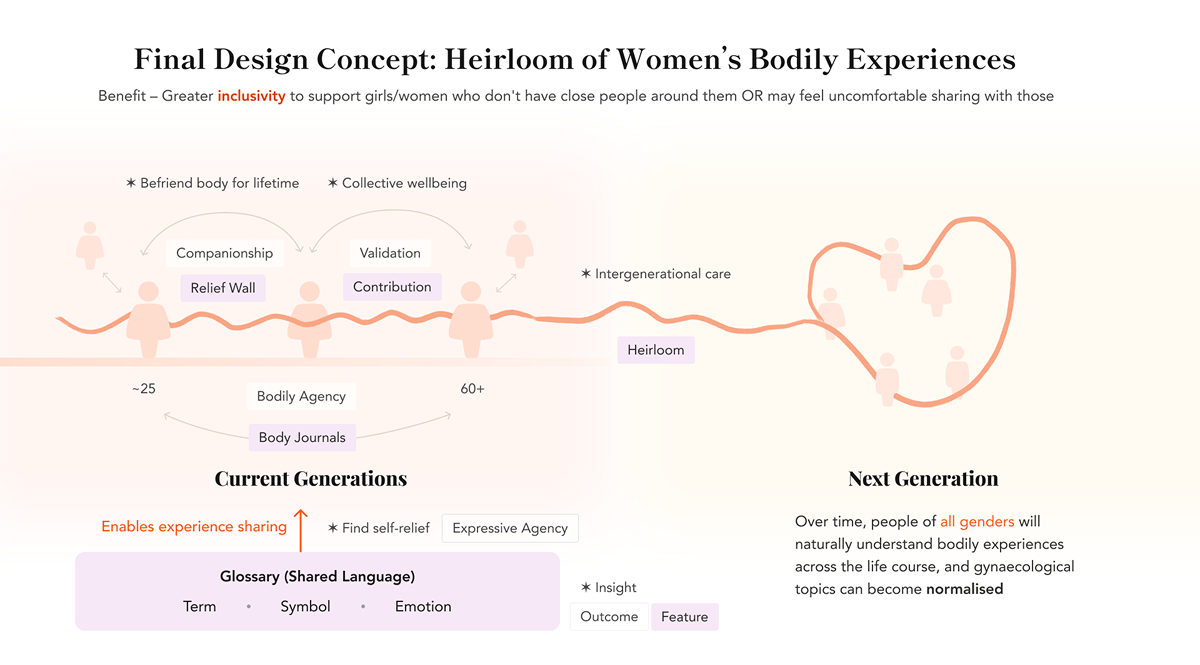
Once every interaction detail was validated through prototyping, I finalised the design concept: an heirloom of women’s bodily experiences.
Fundamentally, expression enablers empower users to build a shared language together — terms, symbols, emotions — so that women of all ages can articulate and share bodily experiences that words alone cannot capture. Interactive community features deepen this emotional connection, encouraging more women to open up and gradually piece together the full picture of gynaecological health across every life stage. When talking about gynaecological health becomes a norm, we may start seeing parents teaching daughters and sons, men learning and passing it on to male friends, teachers openly educating little boys and girls. Eventually, the heirloom will equip future generations, regardless of gender, not only to learn about these experiences, but to carry a natural instinct to care for the women around them — and to use their own influence in society to do so.
03 Refine & Realise
Branding
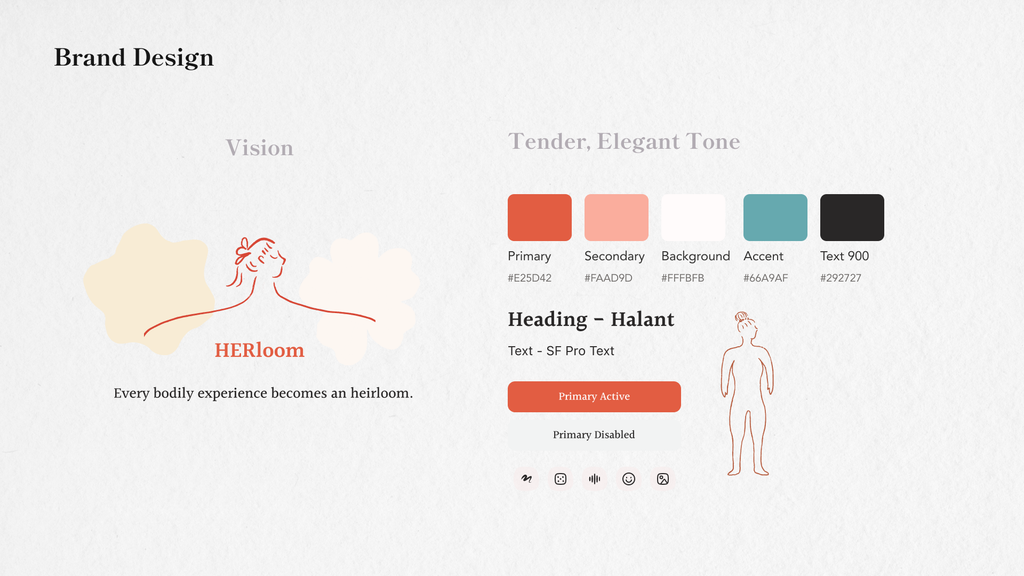
I developed a design system tailored to the product’s vision. The brand speaks to users in a tender, elegant tone.
Hi-fidelity prototyping
Three scenarios were deliberately set to validate that all user outcomes (expressive & bodily agency, validation and companionship) were achieved. The testing showed that participants felt seen and heard, and that contribution counts encouraged them to create and share more of their own language.
What surprised me most was the feedback from two participants, who said they felt safe not only because the service was anonymous, but because the creative way it approached the body created a sense of distance from reality, making it less stressful to share openly with others. This was especially worth noticing since they had initially preferred to stay as passive information receivers. That was the moment I began to see the product’s potential to break the silence around gynaecological health in Taiwan.
04 Design Summary
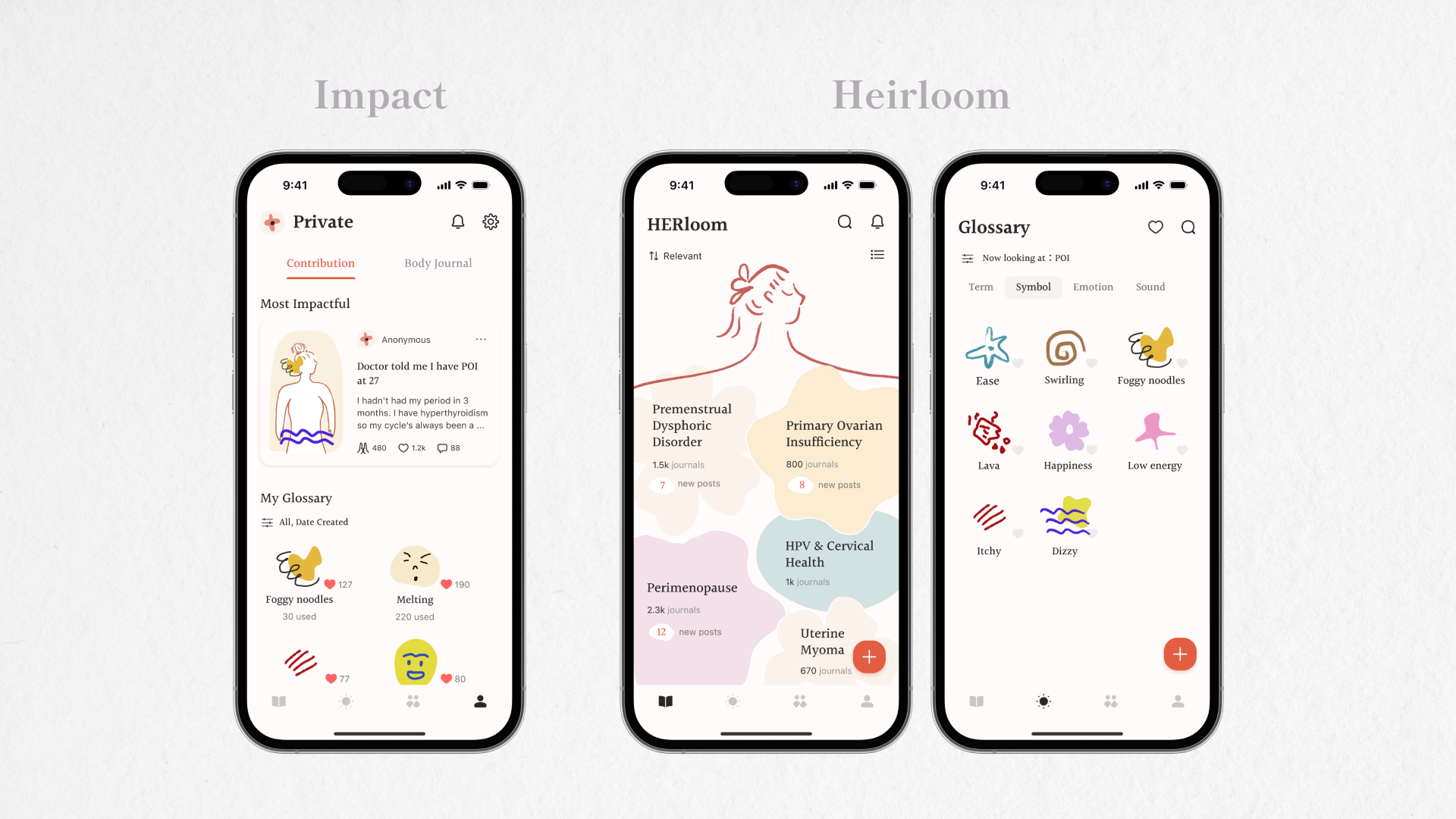
Through Expression Enablers, users are able to build their own language to express and share their bodily feelings in Body Journals. Since symptoms affect everyone differently, learning from others’ lived experiences gives users greater bodily agency to navigate unfamiliar physical changes with reassurance.
The Glossary brings together all the creative language every user has built. This marks a key innovation since none of the competitors offer a communication system entirely built and evolved by their users.
There are countless terrifying, anxious, or helpless moments women have to face alone: sitting in the waiting room, having to deal with work while fighting cramps, insomnia and hot flashes hitting at once in the dark of night. The Relief Wall is there for women to hold each other up in those moments.
My Contribution lets users find validation — for instance, by seeing how many times their created language is used in others’ body journals, or how many users find their sharing meaningful. It affirms that their experiences are real, worth being taken seriously, and can inform others, including this and the next generation. Ultimately, all women’s bodily experiences and the shared language (Glossary) they have built are preserved as a living Heirloom to pass down for generations to come.
Highlight of Features
05 A Brighter Future
With women’s bodily experiences at its heart, HERloom can act as a catalyst for breaking the perpetuating cycle of silence around women’s health. It has the power to bring doctors, designers, and researchers together to improve women’s health across multiple areas of society. As shared understanding ripples outward, it cultivates greater cultural empathy over time — toward normalising the topic, providing better care for women around us and potentially promoting gender equality.
06 Closing & Next Step
There are two critical learnings that deeply inspired me. I want to share them with anyone who is also curious about women’s health.
PAIN gap is shaped by lived experience. It goes deeper than gender. Even among women, it is hard to truly grasp what severe gynaecological conditions feel like without having lived through them: facing relentless discomfort day after day, month after month, and praying for it to finally be over. That is not about assigning blame, nor does it mean someone has to suffer to understand; in fact, women living with pain would never want others to understand them that way. What I can share with you, from the unspoken struggles I witnessed across 30+ participants, is this simple wish: believe their pain, and do not trivialise it.
And, if we can put gender aside. Androcentric history has meant women’s health has never been merely a medical issue. We are still living with the consequences today. Yet at the most human level, supporting someone through gynaecological pain or discomfort should not be complicated—it can be as natural as checking in on a friend with a bad cold. I genuinely believe it comes from the same human instinct that makes us want to care for the people we love, and to extend that same care to the women we encounter in everyday life.
My next big focus is getting HERloom out to more people and making sure it can truly thrive. If you’re interested in women’s health too, feel free to reach out — I’d love to connect!