MSc Ergonomics & Human Factors student and Human Factors senior engineer at Frazer-Nash Consultancy, with an undergraduate background in Psychology.
Major Project
A Human Factors and Design Investigation into the Television Viewing Experience of ‘Casual’ Boxing Followers.
Boxing on the whole appears to struggle to consolidate ‘casual’ followers who have a long-standing but passing interest in the sport and watch its biggest events, into more frequent and dedicated fans.
It was speculated that the television viewing experience is lacking for ‘casual’ boxing followers in the following ways: – The viewing experience is not immersive and involved enough to grow interest in the sport. – The ‘casual’ viewer is not provided enough context around the content they are watching to sufficiently understand and engage with it, and thus is not encouraged to become a more regular follower.
The findings and analysis suggest that a more customisable, dynamic, and interactive offering would be favoured over what is currently being provided to viewers.
As the research was novel, further methodological refinement and exploration is required to show a distinct, positive effect on television viewing experience for ‘casual’ boxing followers.
Study Protocol Text overlays (left) featuring technical, boxing-based statistics were included in video clips. Participants would watch one edited clip, and one unedited during the study session.
Text overlays (right) also featured the boxers’ personal narratives and facts about their careers and background. This was intended to contrast from the technical statistics, with focus groups later investigating participant preferences in relation to their viewing experience.
Interactive features and online polls were also included in the edited condition, to give participants greater context and immersion during the session.
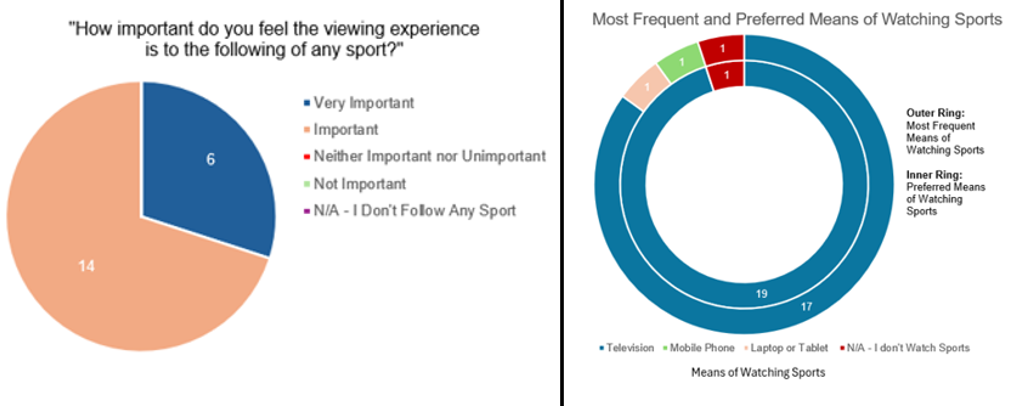
Pre Study Questionnaire Findings It was necessary to understand the participant perspective on the importance of viewing experience due to the research question, and to understand baseline feelings towards watching sports. All participants believed the viewing experience was at least important, with six stating it was ‘Very Important’.
Watching sports on television was also the most frequent and preferred means of the 19 participants who do watch sports, thus providing alignment with the research protocol.
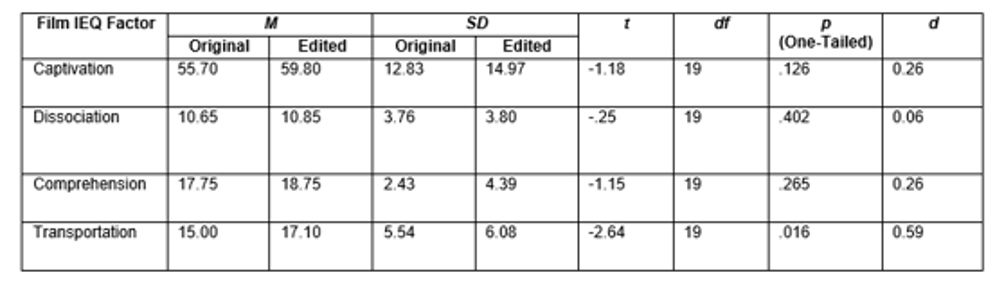
Film IEQ T Test Results Participants undertook the Immersive Experience Questionnaire for Film and Television (Film IEQ, Rigby et al., 2019) after viewing an edited and unedited video clip.
Across the four factors of the IEQ, only Transportation saw a statistically significant increase in the edited video condition compared to the original.
Transportation was defined as “How much the user felt like they were experiencing events for themselves, and how much they felt they were located in the world portrayed in the video”.
Focus Group Findings Five themes emerged from a thematic analysis (Braun & Clarke, 2006) of the focus group transcripts, providing a qualitative assessment alongside the Film IEQ results. This provided support for the additional context provided, and areas for further refinement and improvement.
Focus Group Findings A word cloud from the transcripts of participant focus groups, where topics included. – Views on the design interventions. – What their preferred televised sports viewing experience includes and does not. – The importance of narrative and personality in relation to sportspeople. – General interest and understanding around the sport of boxing.
Module Coursework Examples
Human Factors & Systems An AcciMap of the 2018 Notting Hill Gate station ‘Trap and Drag’ incident.
The aim of this work was to understand the factors associated with the incident. This presents them across several domains, with arrows demonstrating which factors have impacted on or contributed towards others.
Interaction & Experience Design A group project to create a mobile banking application, which sought to address the problem statement “Mobile banking is the future, but to many less-experienced people, it seems complicated, and its benefits are not clear”.
User personas were created, with prototype testing undertaken using printed copies of the phone screens shown above. Participants were instructed to complete tasks using the mock-up app screens, with feedback on navigating and understanding the app then used to refine the screens.
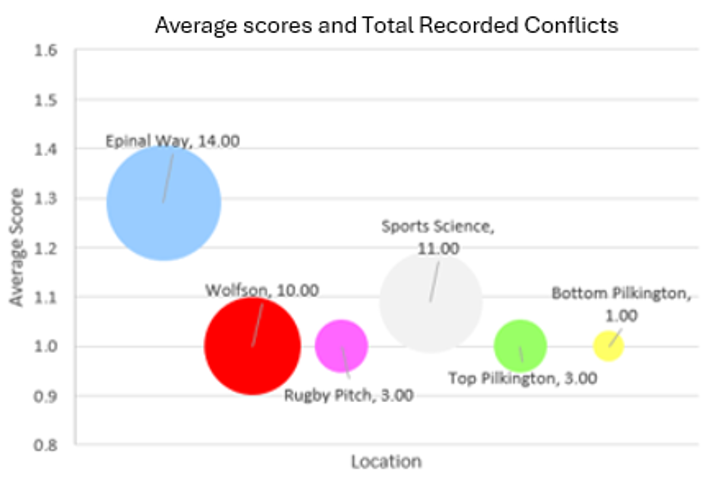
Transport Safety Observations of traffic conflict on the Loughborough University campus, undertaken on a quiet Friday morning, for fifteen minutes each at six locations. All conflicts were given a severity score from one to five.
The graphic presents the average severity score of each location observed, with the area of each bubble equating to the total number of conflicts observed.
This task aimed to understand transport safety on campus, and to consider how this could be improved.