MSc Ergonomics and Human Factors graduate with a background in International Business and automotive manufacturing experience in health, safety and environment. Interested in exploring overlooked areas of ergonomics through innovative research, alongside a strong longstanding passion for music and performance.
The Effects of Music Stand Position andTime-Related Fatigue on Physical Strain, Cognitive Workload, and Performance Accuracy During Musical Sight-Reading Tasks.
Background
Musical performance places simultaneous physical, visual and cognitive demands on performers, yet ergonomics within music remains comparatively underexplored. Research often considers posture, visual processing, workload and fatigue separately rather than examining how they interact during performance.
Music stand position is one overlooked but modifiable factor. In ensemble settings, notations may be positioned laterally, requiring musicians to compensate through head and body rotation or increased visual effort. From a Human Factors perspective, this makes stand position part of the wider performer-task-environment system, rather than simply an issue of individual posture.
Importantly, musicians may maintain successful performance while using additional physical or cognitive effort, meaning performance alone may not reveal the ergonomic cost of an unsuitable setup. This study therefore examined how stand position affects posture, fatigue, cognitive workload, and musical performance.
Aims and Research Questions
Aim: To investigate how different music stand positions influence postural asymmetry, physical discomfort, fatigue, cognitive workload and musical performance during sustained musical sight-reading.
Research Questions:
How does music stand position influence postural asymmetry during musical sight-reading?
Do physical discomfort, physical fatigue and mental fatigue differ between music stand positions?
How do physical and mental fatigue change across the experimental session?
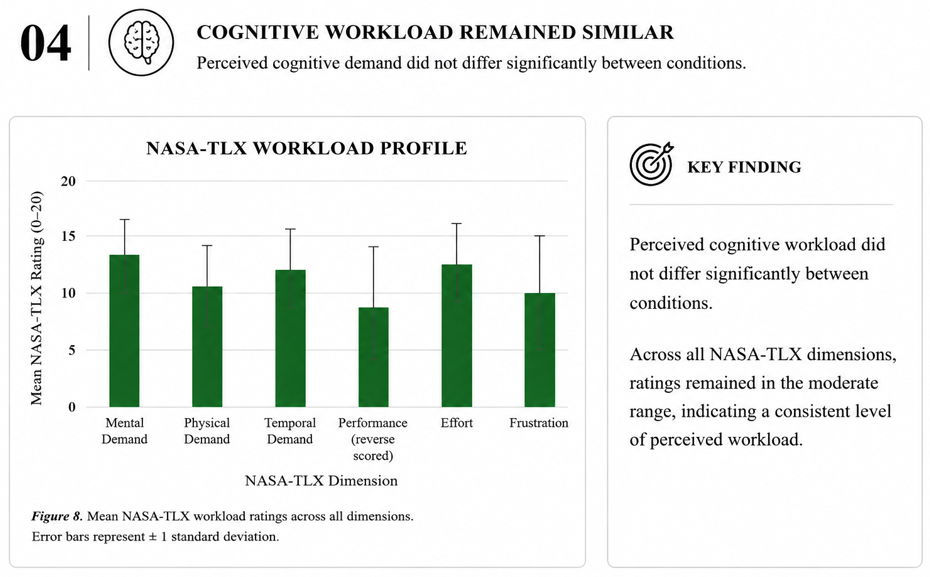
What is the overall cognitive workload experienced during sustained musical sight-reading?
Does music stand position influence musical performance during sight-reading?
How do musicians perceive the physical, visual and performance demands associated with different music stand positions?
Together, these research questions examine four interconnected areas of demand during musical sight-reading:
This allowed the study to examine not only whether performance changed, but how musicians physically and cognitively adapted to different music stand positions.
Methods
A within-subject repeated-measures design was used with 12 university musicians aged 21-27. Each participant completed all three music stand conditions, allowing direct comparison within the same musician while reducing the influence of differences in instrument, playing experience and habitual posture. Condition and music order were fully counterbalanced to minimise learning, familiarisation and fatigue-related order effects.
Each condition involved 15 minutes of unfamiliar sight-reading while standing; the three conditions were:
NormalHead-TurnVisual
Normal – Music positioned directly in front at approximately eye level.
Head-Turn – Music positioned approximately 45° to the right, with participants turning towards the notation.
Visual – Music positioned approximately 45° to the right while participants remained forward-facing, increasing reliance on lateral visual access.
Why this approach?
Controls individual differences: Each musician completed all three conditions, allowing direct comparison within the same participant/
Reduces order effects: Counterbalancing helped minimise the influence of learning, famiiarisation and fatigue across conditions.
Captures the whole experience: Combining video analysis, performance measures and self-reported responses allowed physical, cognitive and performance demands to be considered together.
Results
The results revealed three clear patterns: postural asymmetry changed with stand position, fatigue increased across the session, and musical performance remained comparatively stable despite differences in ergonomic demand.
Participant Experiences: Qualitative responses supported the quantitative findings, with participants describing differences in visual effort, concentration and physical comfort between stand positions. Lateral positioning was commonly associated with increased visual scanning and distraction, while some participants reported greater physical awareness when turning towards the music. Despite these additional demands, participants generally felt able to maintain their musical performance, suggesting that musicians adapted their strategy to compensate for less favourable stand positions.
Contextual Factors: A small number of participants reported temporary factors that may have influenced their responses during testing, including feeling overheated and, in one case, feeling faint. These experiences may have contributed to higher ratings of physical discomfort or fatigue independently of the experimental conditions. As these factors were not part of the planned manipulation, they were treated as contextual observations rather than study outcomes and should be considered when interpreting individual responses.
What Do These Findings Tell Us?`
Together, the findings suggest that musicians can maintain performance even when the physical demands of the setup change. This indicates that performance outcomes alone may not reveal the ergonomic cost of a rehearsal setup.
These findings highlight the importance of looking beyond performance outcomes when evaluating musical environments. Musicians may maintain successful performance while adapting physically or perpetually to the demands of the setup. From a Human Factors perspective, the aim should therefore be to support performance while minimising unnecessary physical and visual compensation.
Practical Implications
Prioritise direct visual access: Music should be positioned to minimise unnecessary head rotation and excessive visual scanning wherever possible.
Make the setup adjustable: Music stands should allow flexibility in height, distance and angle, so performers can adapt the setup to their own posture and visual requirements rather than relying on one “ideal” position.
Plan for sustained performance: During longer rehearsals and performances, opportunities for postural variation, short breaks and recovery should be considered, particularly when lateral or asymmetric positioning cannot be avoided.
Conclusion
Music stand position influenced how musicians adapted during sight-reading, particularly through differences in postural strategy and visual demand, while observed musical performance remained broadly stable across conditions.
These findings suggest that successful performance does not necessarily mean equivalent ergonomic demand. Musicians may maintain performance by compensating physically or perceptually for less favourable setups, meaning important demands may not be visible from performance outcomes alone.
From a Human Factors perspective, the goal should therefore be to reduce unnecessary compensation through direct visual access, adjustable stand positioning, individual performer needs and opportunities for recovery, rather than prescribing one universal ‘correct’ setup.
Module Coursework
Alongside the final project, the MSc encouraged me to think creatively about how Human Factors and Ergonomics are communicated. Coursework required me to work across different formats and applications, using tools such as SPSS, Excel, GoodNotes and ProCreate to analyse data, develop visual material and transform research into clear, engaging and accessible outputs.
Occupational Ergonomics
Communicating workplace risk through design: This project explored how occupational health and safety information can be transformed into clear, engaging and actionable communication. Focusing on welding-fume exposure, I designed a visual safety campaign that communicates both the potential health consequences and the practical controls workers can use to reduce exposure.
Rather than presenting technical guidance as dense information, I used visual hierarchy, contrasting imagery and concise messaging to prioritise the most important actions, controlling fumes at source, using appropriate PPE and recognising adequate control measures. The project challenged me to consider not only what information workers need, but how it should be communicated to support attention, understanding and action.
How the message was structured:
What I took from this project: This project strengthened my ability to translate occupational health guidance into concise visual communication, considering how design can support attention, understanding and safer decision-making in the workplace.
Interaction and Experience Design
Designing and evaluating an interactive museum experience: PastPort was developed as an interactive museum app concept designed supporting exhibit discovery, event booking and continued visitor engagement. The project applied Human Factors and UX principles to investigate whether the interface was intuitive, accessible and aligned with users’ expectations.
Usability testing examined more than whether users could complete each task. I observed navigation behaviour, hesitation, errors and verbalised expectations, revealing instances where successful task completion still involved uncertainty or unnecessary cognitive effort. The observations were then translated into practical design recommendations.
What happened when users tried it?
83% – Exhibit Discovery: 5/6 users completed the task. The main friction occurred during navigation, with users expecting map-based exploration to appear earlier in the journey.
100% – Event Booking: 6/6 users completed the task. Despite full task success, users still showed hesitation around selection and booking confirmation, showing that completion did not necessarily mean the interaction was effortless.
100% – Guest Pass: 6/6 users completed the task. This was the smoothest interaction, with users navigating the rewards flow confidently and with minimal hesitation.
Three interactions. Three different user experiences.
Exhibit DiscoveryEvent BookingConfirmation
The key finding: Successful does not mean effortless. High task completion masked moments of hesitation, uncertainty and additional cognitive cost.
What I took from this project: Successful task completition does not necessarily mean a successful user experience. This project strengthened my ability to evaluate interactive systems from the user’s perspective and translate usability findings into practical design improvements.
Physical Ergonomics
Evaluation of Household Waste Handling
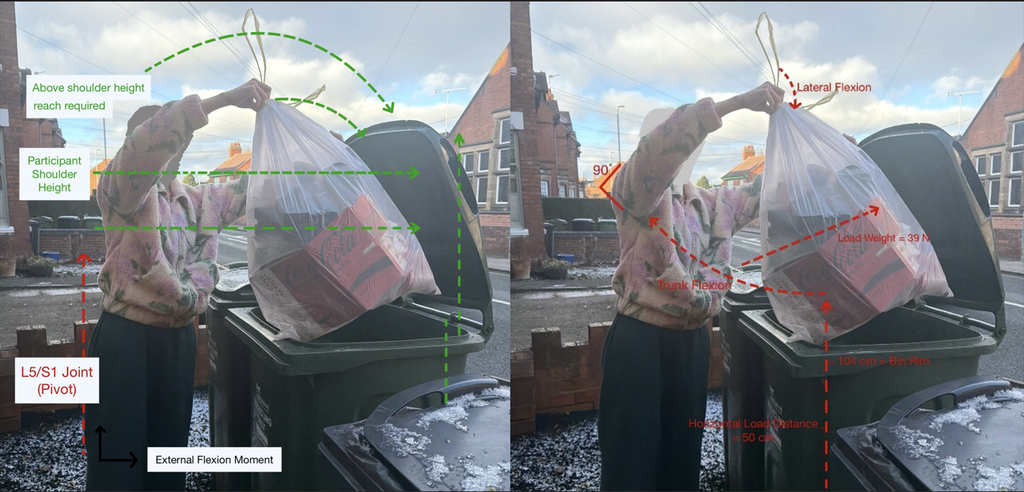
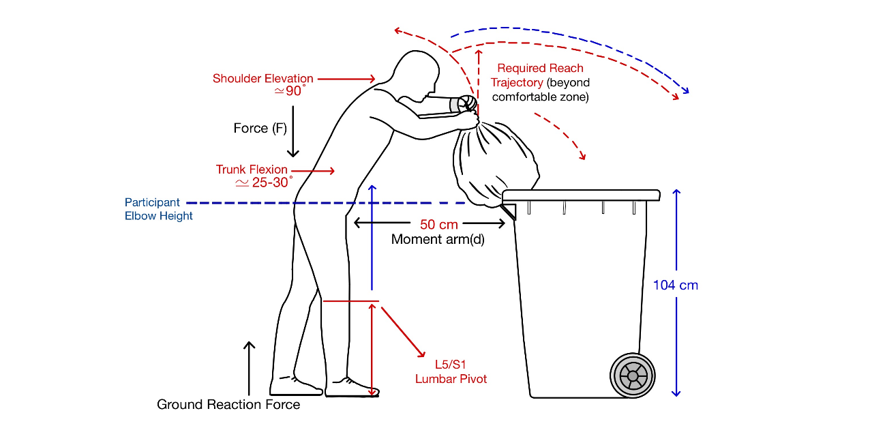
Evaluating physical demand in an everyday task: This project applied physical ergonomics methods to evaluate the seemingly simple task of emptying household waste and transferring it to an outdoor wheeled bin. Anthropometric, postural, anatomical, biomechanical and physiological analyses were combined to identify where task design created unnecessary physical demand.
Postural Analysis: Drawn Outdoor lifting and Tipping Exercise
The load was relatively light – the way the task was designed created the risk.
Where did the greatest physical demand occur: the outdoor lifting and tipping phase emerged consistently as the most physically demanding stage. The elevated bin rim forced the load above the participant’s optimal working zone, while forward reach and asymmetric handling increased shoulder and spinal loading.
Proposed Redesign Interventions:
Reduce lift height: Lower the effective outdoor bin opening to reduce shoulder elevation and upper-limb loading.
Improved grip: Introduce wider, more secure handles to reduce localised grip pressure and improve load control.
Reconfigure the workspace: Increase clearance above the indoor bin to enable a more upright working posture.
Improve the route: Reduce slip and trip risk through improved surface conditions and routine hazard removal.
Dimensional Characteristics of Outdoor wheeled binFree Body Diagrams – Indoor and Outdoor
What I took from this project: Physical demand is not determined by load alone; it emerges from the interaction between the user, task, equipment and environment. This project strengthened my ability to combine anthropomentric, postural, biomechanical and physiological evidence to identify ergonomic risk and translate analysis into practical, inclusive design recommendations.