

Since 2000, the NHS journey with patient safety has been well catalogued. However, the introduction of PSIRF signalled a clear shift away from root cause analysis and towards systems-based investigations, with the utilisation of SEIPS. Incidents that receive a formal learning response, however, only make up a small percentage of incidents reported. This study looked to understand how incidents that do not fit within the PSIRF pathway are managed and the challenges to utilising systems thinking and human factors (HF) tools when investigating them.

A mixed-methods approach was undertaken. Phase one comprised a retrospective review of locally managed incident records using the Yorkshire Contributory Factors Framework (YCFF). Phase two involved semi-structured interviews with incident managers to evaluate whether human factors (HF) principles were evident in local incident investigations and, if not, to identify the underlying challenges and barriers to their utilisation.

A minimum of one YCFF domain was identified in every incident record reviewed. The number of domains identified per incident ranged from one to four, with the majority of incidents coded to either one or two domains. A total of 353 domain occurrences were identified across the 203 records. ‘Slips and Lapses’ was the most frequently identified domain, occurring in 74 records (36.5%), followed by ‘Communication’ in 68 records (33.5%). Together, these accounted for 40.2% of all domain codes and were identified in 69% of incidents. These findings reflect factors identified in the documented output of the investigation.

Four themes were identified from the interviews. It was noted that there was variation in how participants understood systems thinking, and its interplay with accountability and human error. The development of investigation capability was also inconsistent, with varying levels of training, experience and support. Organisational factors formed a major group of challenges in conducting investigations, with time, access to information and access to staff cited most frequently. Finally, some participants expressed frustration with implementing actions and translating learning into change.
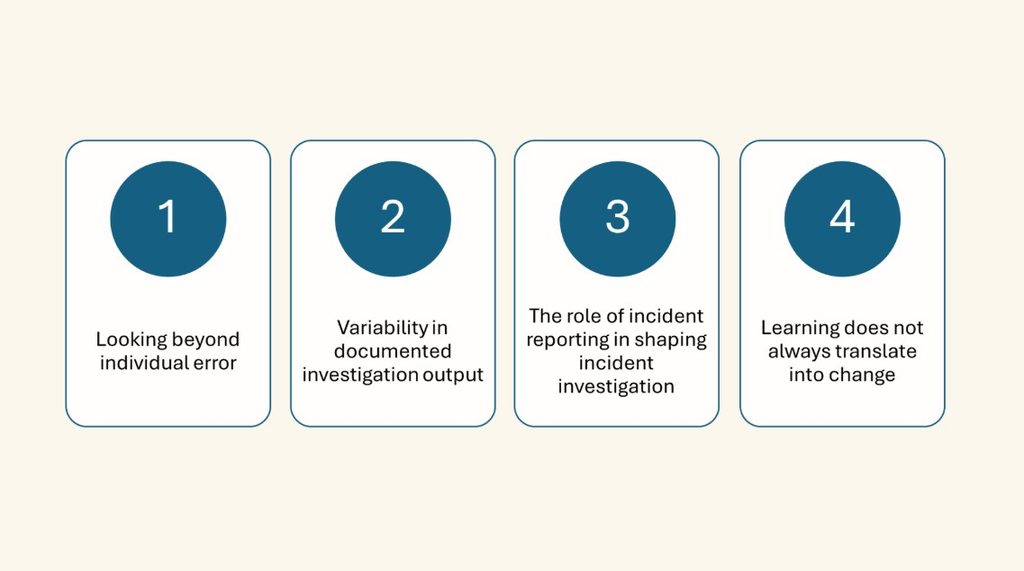
Overall, the findings suggest that human factors and systems thinking are not consistently incorporated into incident investigations outside the PSIRF pathway. Participant responses suggested some tension between systems thinking and individual accountability, particularly where an incident was perceived to have resulted primarily from an individual action or error. This was also reflected in the YCFF findings, with ‘Slips and Lapses’ the most commonly identified domain. There was also no standardised approach to conducting these investigations, reflected in variation in training, support and documented investigation output. Incident reporting emerged as an important issue, particularly in how reporting practices may influence which incidents are reported and subsequently investigated, although this was not explored in depth within the study. Finally, staff described limited time and resources, alongside difficulties translating learning into meaningful improvement.