I’m a UX designer with a background in Landscape Architecture and an MSc in User Experience Design. My work focuses on inclusive, research-driven design, exploring how emotional states influence digital engagement and how thoughtful design can support accessible user experiences.
Designing and Evaluating an AI Micro-Coaching Companion to Reduce Digital Task Avoidance Through Emotional Preparation
Core Problem
What happens when someone experiencing stress / low mood / reduced motivation tries to complete an important digital task?
Literature Review & Identified Research Gap
The gap is that existing studies on digital exclusion have focused predominantly on data tracking rather than providing a solution for a specific task. No existing study has combined a task-specific UX intervention with a direct comparison of interaction modalities to identify which design feature best supports users facing situational, non-clinical emotional barriers when trying to start an avoided task.
Aim
To design and evaluate a micro-coaching mobile application that reduces avoidance of digital tasks by emotionally preparing users experiencing stress, low mood, or reduced motivation
Research Question
What feature of a micro-coaching mobile application best support emotional state and task engagement in users experiencing stress, low mood, or reduced motivation when approaching avoided digital tasks?
Sub-question: Which interaction modality better supports users in expressing their emotional state and feeling heard and understood?
Prototypes
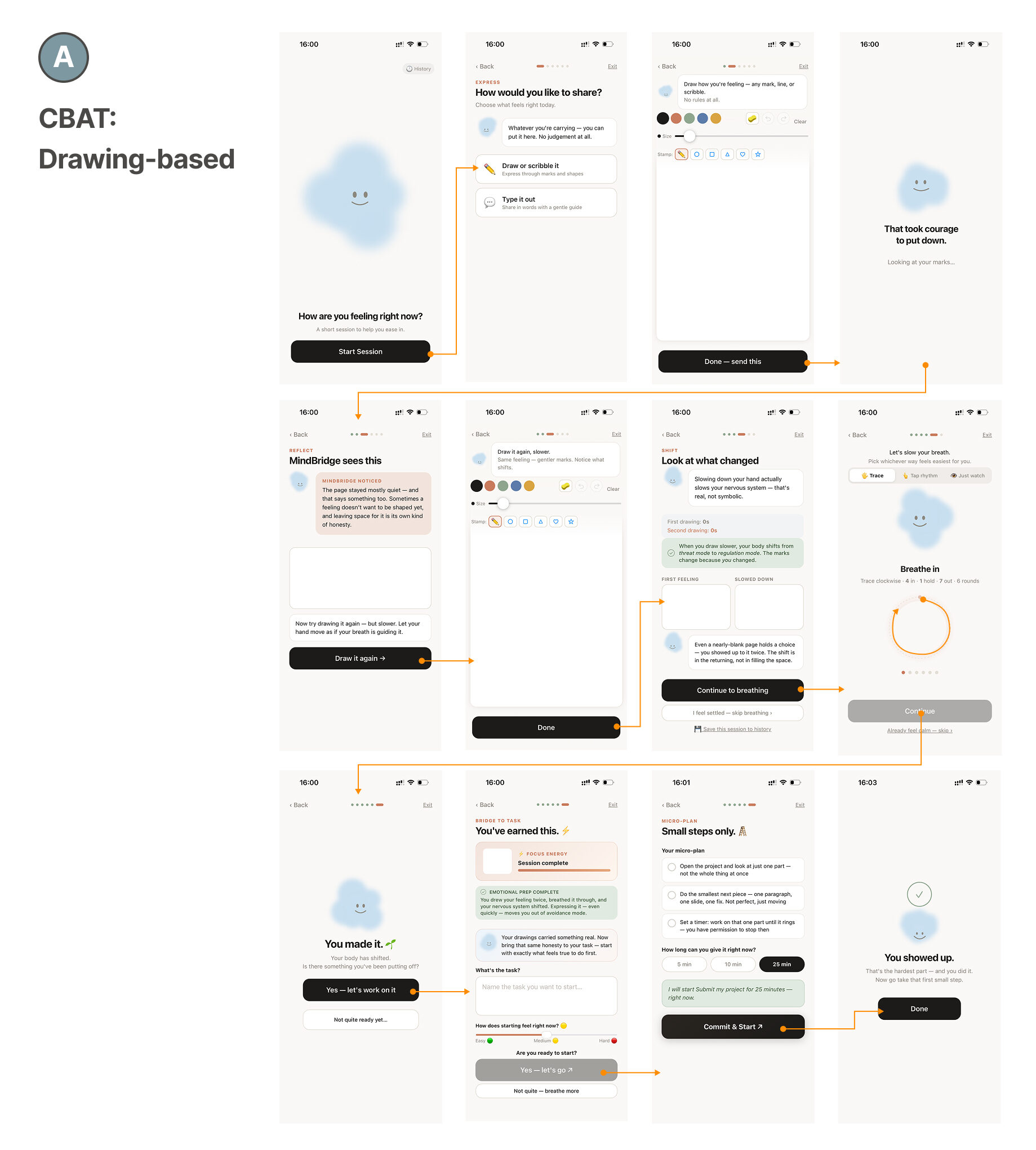
The app process stage for both prototypes follows the shared 6-stage process framework based on established theory. Prototype A applied CBAT (Rosal, 2018), while Prototype B applied CBT (Kennerley, 2017) at each corresponding stage.
The study used both quantitative and qualitative methods to answer the research question, with qualitative data serving as the primary basis for analysis and quantitative data as supporting evidence for the qualitative findings.
Participants were required to meet the criteria of being 18 years or older, having the capacity to fully understand and consent to the research, having had at least one prior experience of avoiding or putting off a digital task due to feeling stressed, overwhelmed, or unmotivated, and being willing and able to engage in a short role-play scenario during the session. This is because it requires participants to draw on relevant experience of task avoidance so they can recall the feeling.
A sample of 16–24 participants was targeted using a combination of purposive and convenience sampling to meet the inclusion criteria and ensure practical access to participants, informed by existing literature and common industry practice (Hennink et al., 2017).
The within-subject, prototype testing used a counterbalanced order to mitigate carryover effects from improved emotional state. Each participant completed both prototypes with half completing Prototype A first, and half completing Prototype B first. Thematic saturation was tracked throughout data collection. This meant collecting data until saturation was reached or no new themes emerged.
Results of the evaluation
Thematic saturation was reached during coding. The saturation log shows all codes. No new codes emerged across the last seven transcripts (P14-P20), with a total of 17 codes across 20 participants (N=20). This indicates that the sample size was adequate for the qualitative analysis.
Result: Main Research Question
The positive effect is the only one that has a significant difference, of Protoype A higher than B and a large effect size. Quotes from participants also confirm that it helps them feel relaxed, calm and forget their stress for a while.
In the negative effect, no significant difference between the two in how it helped reduce negative feelings. People are more credited with the overall experience of the shared feature, like a breathing exercise instead.
About task engagement also no significant difference between the two, but driven by both shared features on the last screen helped them bridge into the task specifically. Novelty effect and users’ prior habits also affect engagement.
Result: Sub-question
Expressing Emotions
Participants were split nearly evenly. Drawing offered unstructured, embodied release, while texting offered structured logic, often aligning with participants’ personal habits.
Identifying Emotions
Texting won decisively because words provided concrete clarity to resolve emotional ambiguity, whereas drawing remained abstract.
Feeling Understood
14 participants felt more understood by the texting one because of the dynamic conversational replies. However, an interesting trade-off emerged: while Texting was more cognitively accurate, it was often perceived as ‘robotic’, whereas the Drawing one was described as ‘softer and warmer’.
Comparative Preference
It depends on their motivation, mood, and situation. Drawing for quick relief and texting when needing structure and clarity, so many comments suggest to combine both.
Matrix coding verified that the counterbalanced design successfully controlled for order effects.
Conclusion
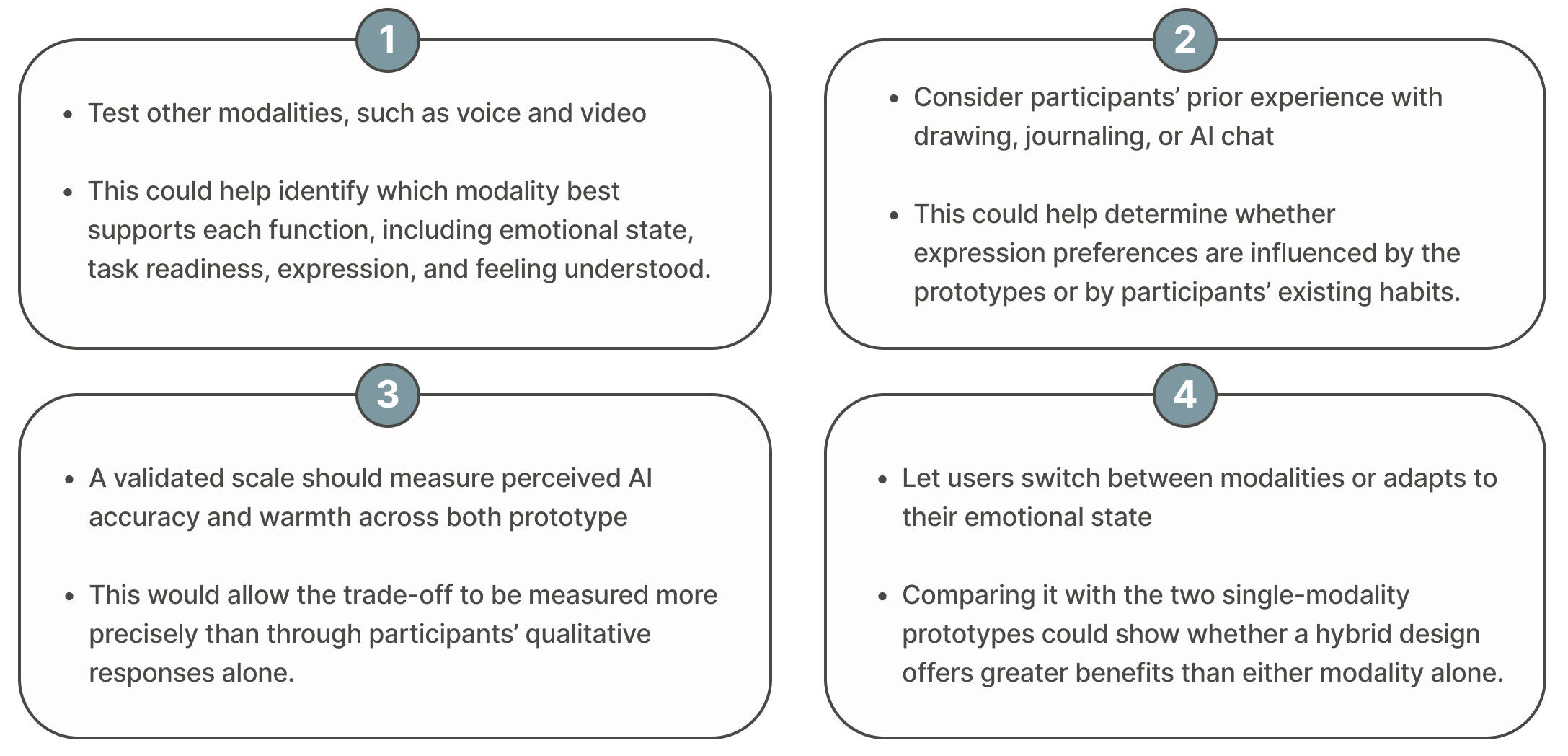
Future Research
No single feature can meet all emotional needs when approaching an avoided task. Future designs should therefore focus on which need each modality addresses and provide flexible tools that adapt to users’ needs.