I am a student from China. My project uses an app as a medium to help middle-aged people in Chinese cities say a proper farewell to their loved ones who have passed away, via a digital memorial platform.
SLOWLY
Overall rendering
Within the app, users can choose to create either a virtual space or an abstract space to help them remember their loved ones.
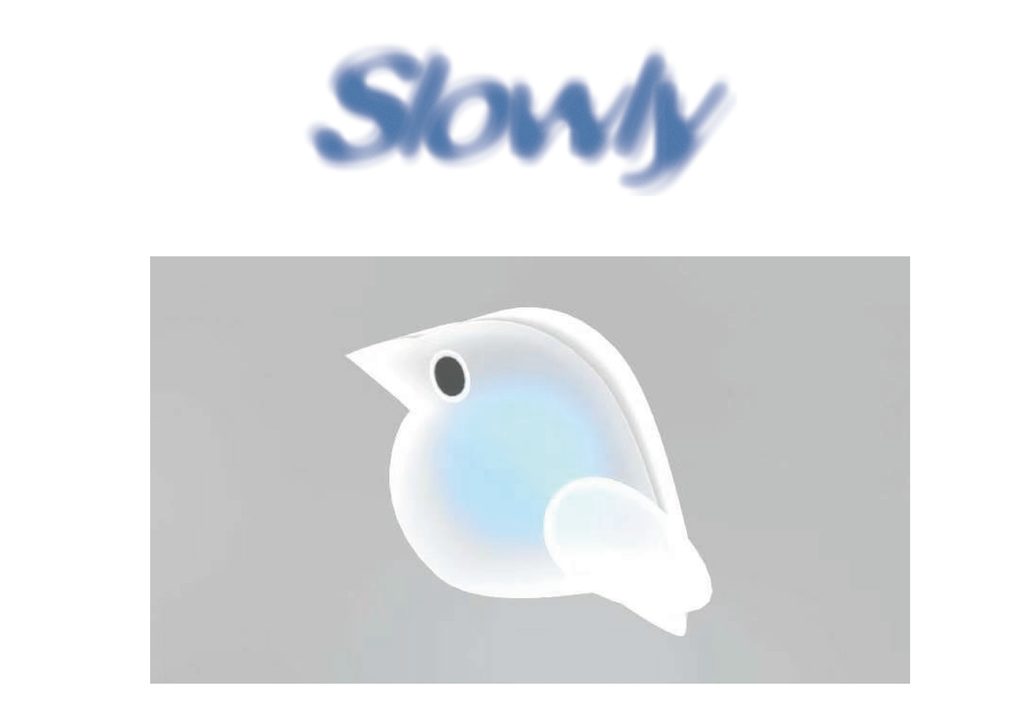
The app features an ‘emotion sprite’ designed to help users assess which stage of grief they are in following the loss of a loved one. The sprite is modelled on a crow. Rather than being portrayed as a mere symbol of ill omen, as is common in modern popular culture, the crow is based on the bird traditionally associated with mourning and wailing at funerals in Chinese culture; furthermore, in traditional Chinese culture, the crow is regarded as a cultural symbol associated with family affection, filial piety and mourning.
Design Details
This design is based on the five stages of grief experienced when a loved one passes away. The five stages are as follows: 1. Denial. The user is in a state of shock, refuses to accept the reality of the situation, and is unwilling to believe that the bereavement has actually occurred. Behaviourally, this manifests as repeatedly viewing old content or playing back the same audio recording over and over. The difficulty lies in the inability to face the situation. 2. Anger. The user projects their grief onto the outside world, possibly blaming others, themselves or fate. For example: blaming doctors for failing to prevent the illness; accusing family members of a lack of care or support; feeling anger towards God or a higher spiritual power; feeling anger or self-reproach regarding one’s own death; or becoming easily irritable or losing patience. 3. Bargaining. The user oscillates between accepting and rejecting the reality, repeatedly imagining ‘if only…’, in an attempt to psychologically alter the facts to lessen the impact. The difficulty lies in the fact that none of these ‘what ifs’ are ever answered. 4. Despair. The user realises the facts cannot be changed and sinks into a state of helplessness and despondency, possibly feeling unable to do anything at all. The dilemma lies in the fact that they lack even the motivation to express themselves. 5. Acceptance. The user accepts the loss as part of life, is able to regain a sense of calm from their grief, and can now live with it. Each stage is presented using different background colours and interactive methods.
The app first uses the ‘Emotion Fairy’ to ask questions and determine the user’s emotional state, after which it takes them to the virtual space page; the background of the virtual space changes automatically based on the test results. Users can choose to create a detailed virtual space or an abstract one for their memorial; through various interactive methods and the ability to build their own space, they can express their individuality and avoid a cookie-cutter approach.
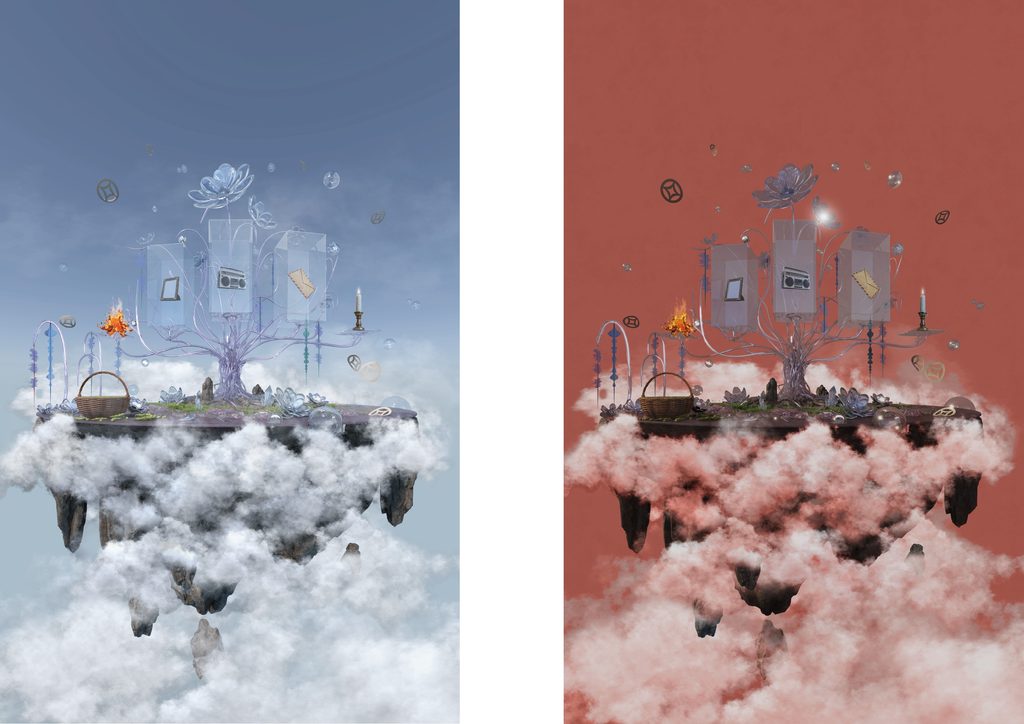
These are the stages of denial and anger, respectively. Interaction during the denial stage: the user is not forced to see clearly. With mist as the central element, a thin haze pervades the entire space, creating a view as if looking through frosted glass. Only when the user focuses on and touches a specific object does it slowly come into focus. Interaction during the anger stage: anger needs to be released through movement. Objects within the space can be tapped to emit a brief sound corresponding to their material and to flash with light. Repeated tapping causes the light to grow increasingly brighter; after a set number of taps, a longer, vibrating sound is emitted.
These are the bargaining and despair phases, respectively. Interaction during the bargaining phase centres on a looping mechanism: users can repeat the same ritual an infinite number of times, leaving behind an extremely faint point of light in the space. As the number of rituals increases, these points of light gradually merge; when the user taps the light, it releases a blurred replay of the ritual. Interaction during the despair phase: companionship requires no words, only presence. When the user touches an object, it emits an extremely brief and faint response. The little spirit shrinks to its smallest size and sinks to the bottom of the space, whilst a faint light continues to breathe at its core.
These are the acceptance stage and the abstract space, respectively. The mode of interaction in the acceptance stage involves a quiet display of the space, creating a warm and gentle atmosphere. In the abstract space, displaying just one or two items is sufficient to guide users in their remembrance.
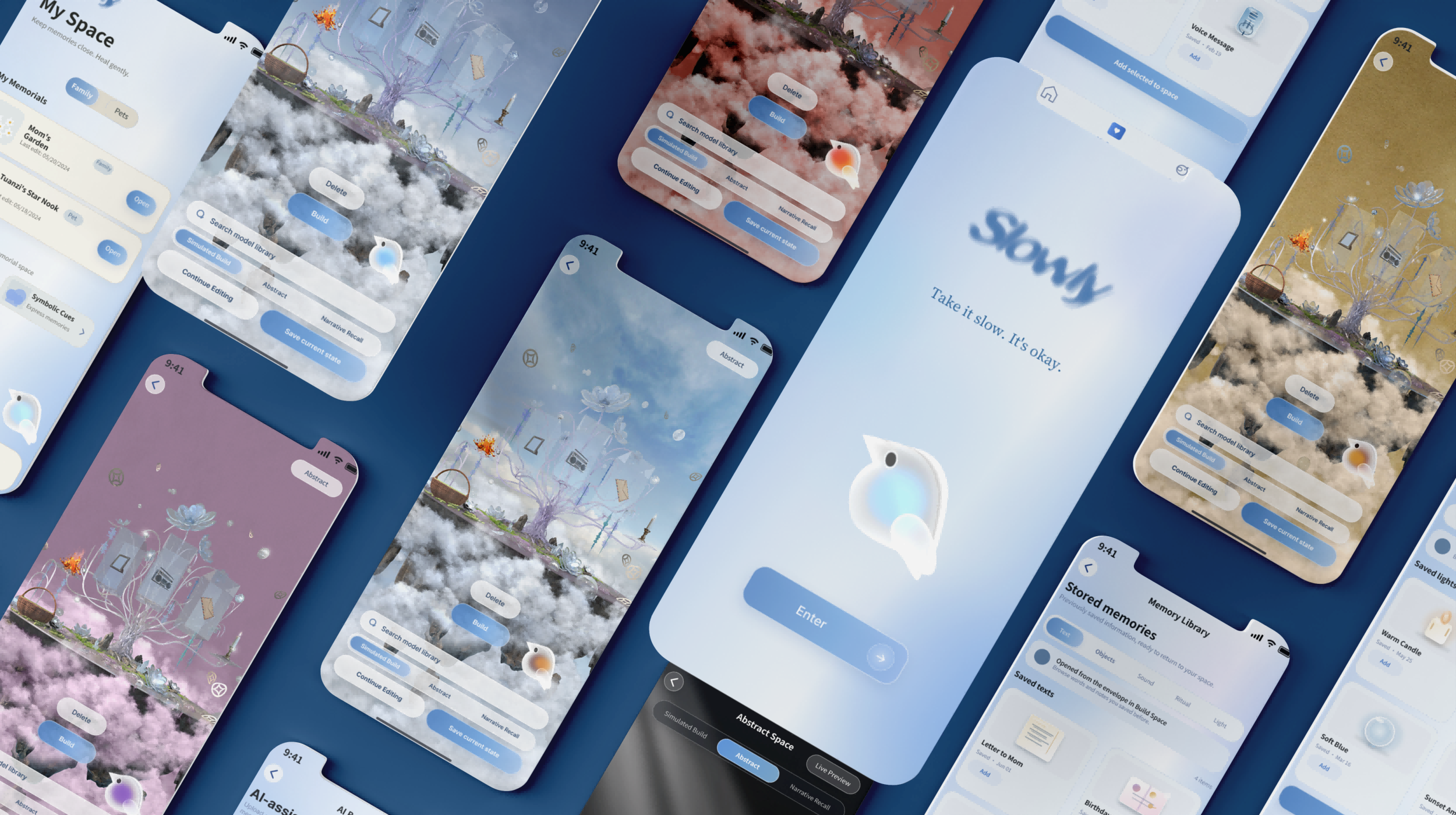
Home page, page for selecting a commemorative purpose, ‘My Space’ page, and ‘Mood Sprite’ enquiry page.
Page interactions corresponding to the five emotional stages, and pages depicting abstract spaces.
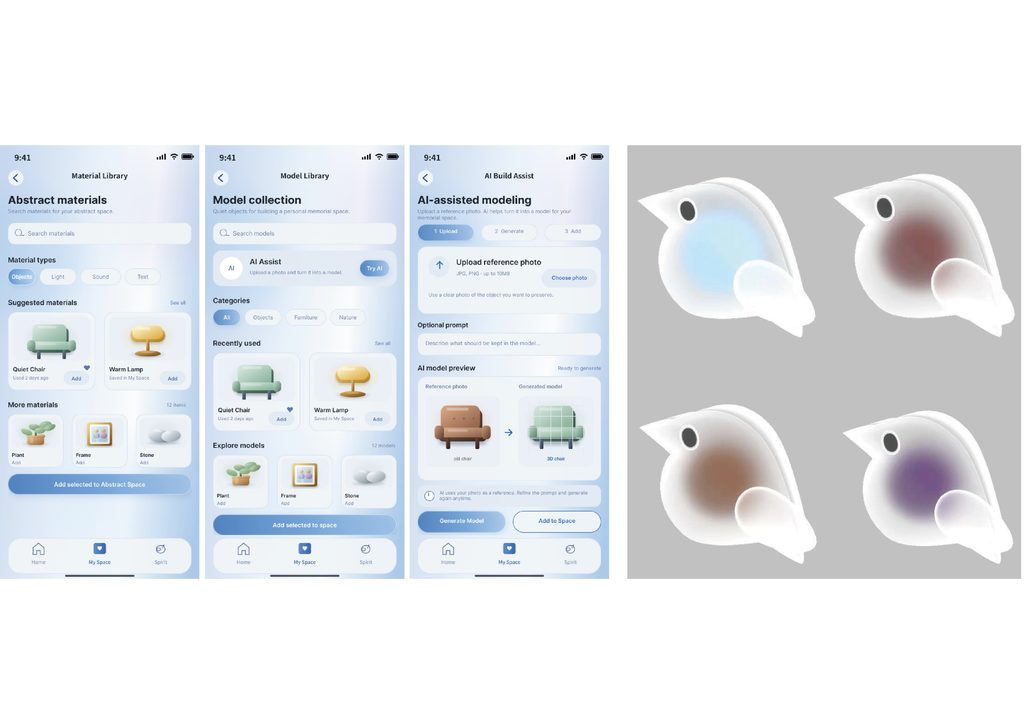
Within the space, you can input content relating to sounds, objects, text, light and traditional Chinese ritual activities. You can also view previously stored content.
When creating spaces, users with no previous experience can be assisted by searching the model library. For models not available in the library, users can upload a photograph, and the AI will then help generate the model. The little elf will also transform according to the different backgrounds of the space and the user’s emotional state.