I am a product and industrial designer with a user-centred approach. Curious and observant, with interests across nature, sports and technology, I enjoy uncovering overlooked problems and developing practical, creative solutions, particularly for sports, outdoor and active lifestyle products.
Improving Indoor/Outdoor Footwear Transition for Outdoor Athletes
Athletes wearing cleats or spikes often need to move briefly from outdoor sports environments into indoor spaces such as changing rooms, clubhouses and facilities. Exposed studs can increase slip risk, damage indoor flooring, wear down cleats and transfer dirt indoors.
This project explores a footwear protection system designed for rapid, hands-free and effortless transitions without removing sports footwear. A flexible two-part structure protects indoor surfaces, contains dirt and adapts to different cleat types while minimising physical effort during use.
User Research & Design Opportunity
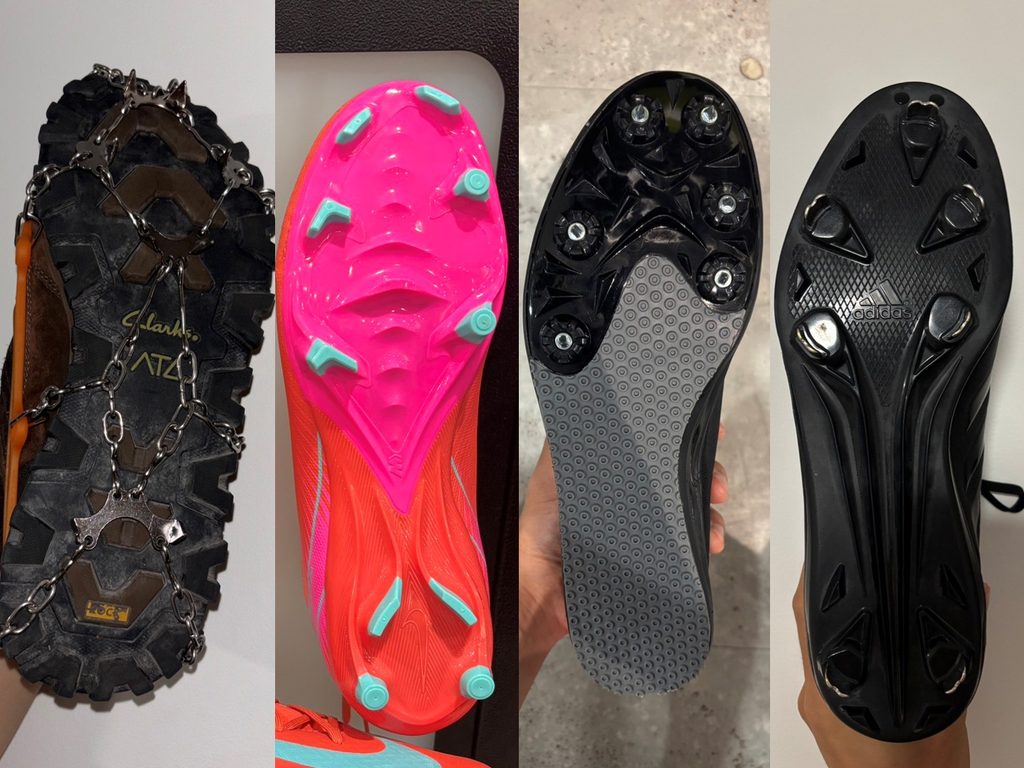
Research across different sports footwear revealed considerable variation in cleat geometry and footwear dimensions, while exposed studs are primarily concentrated beneath the forefoot and heel. Existing protection methods can also require bending, balancing or direct contact with dirty soles.
These findings informed a two-part system that protects the key cleat zones while leaving the midfoot flexible. An adaptable textile connection allows the front and rear sections to accommodate different footwear lengths, contain debris and support easier hands-free interaction.
Cleat and spike configurations across different footwear, highlighting variations in geometry and distribution.
Existing solutions can require bending, balancing and direct handling of dirty footwear during transitions.
Early concept development translating research insights into an adaptable two-part protection system.
From Concept to Functional Prototype
The two-part concept was developed through iterative prototyping, progressing from low-fidelity models to a functional prototype. Early models explored overall geometry, interaction and the flexible connection between the front and rear sections.
The design was then refined through CAD and physical fabrication. Flexible TPU shells were developed to provide protection while accommodating footwear geometry, with EVA cushioning used to isolate the cleats from indoor surfaces. Elastic textiles and detachable snap fasteners were integrated to provide adaptability, dirt containment and easy disassembly for cleaning and maintenance.
Low-fidelity prototyping explored the two-part architecture, proportions and flexible connection.
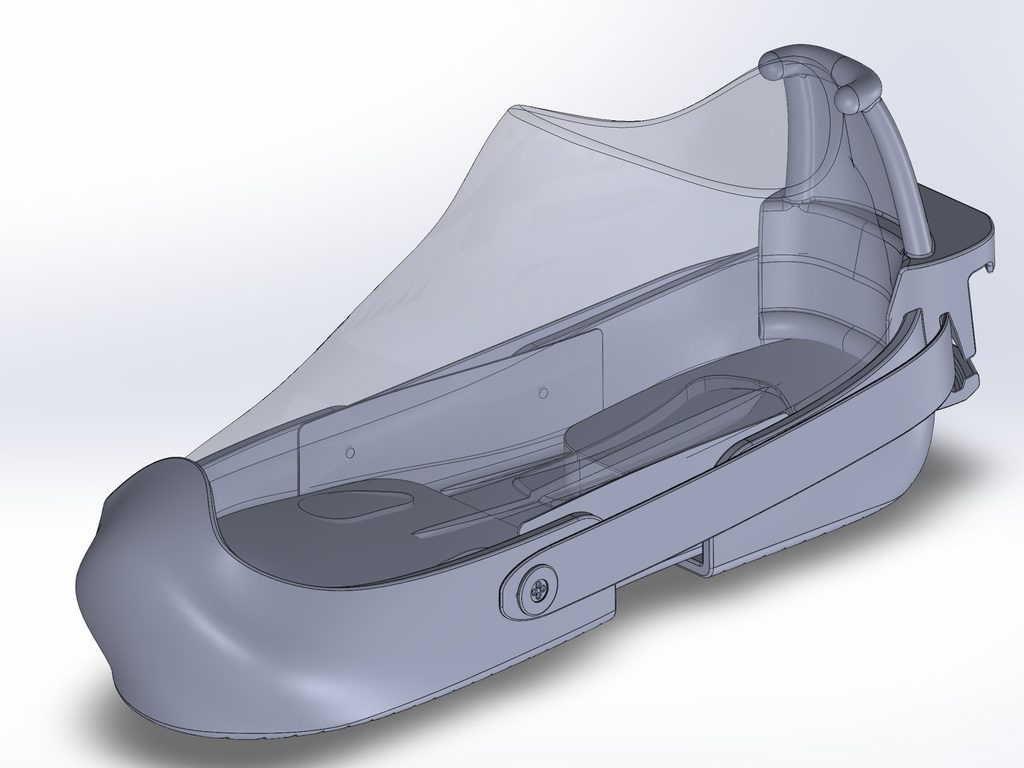
CAD development explored footwear fit, shell geometry and the integration of protective and cushioning components.
Physical fabrication combined flexible TPU shells, EVA cushioning, elastic textiles and detachable snap fasteners, alongside the development of a rigid heel assist for hands-free interaction.
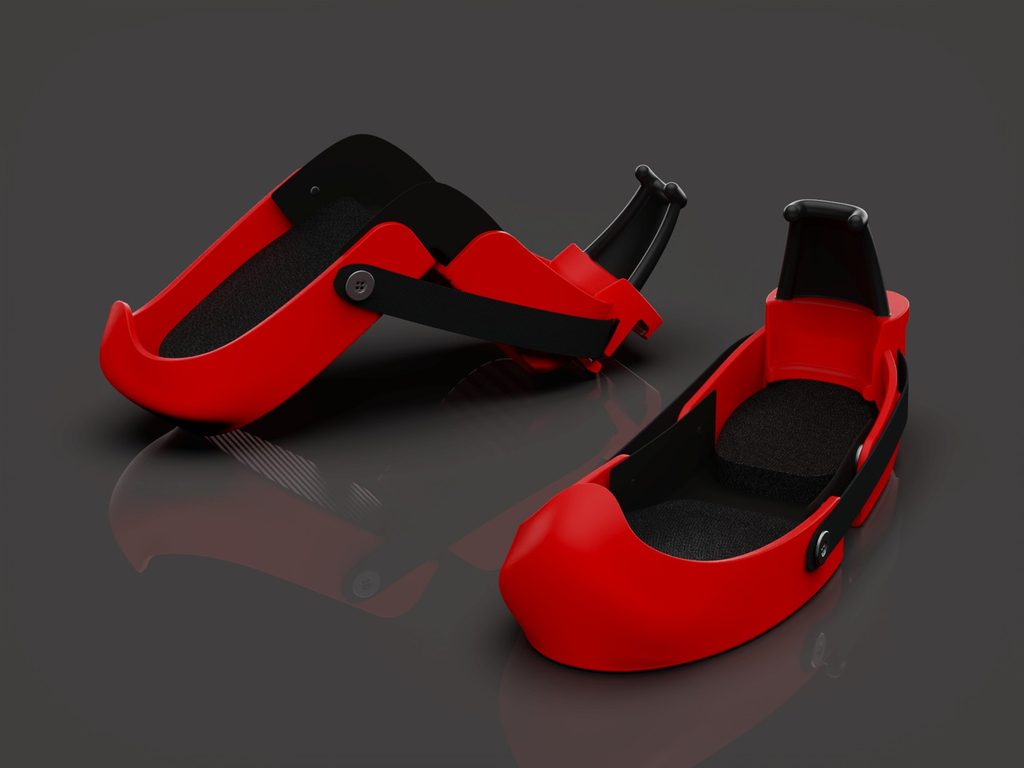
The functional prototype demonstrated the open and closed configurations of the two-part system developed for hands-free interaction.
Iteration of the functional prototype with different heel-assist configurations and cleat types.
Functional prototype demonstrating the open and closed phases with football cleats. The toe enters the front section first, followed by a downward heel movement that closes the rear section around the shoe.
Testing & Design Refinement
Functional and user testing evaluated fit, donning and removal, dirt containment, cleaning, reassembly and overall interaction with different sports footwear. Participants were able to complete the main tasks successfully, while testing also revealed opportunities for further refinement.
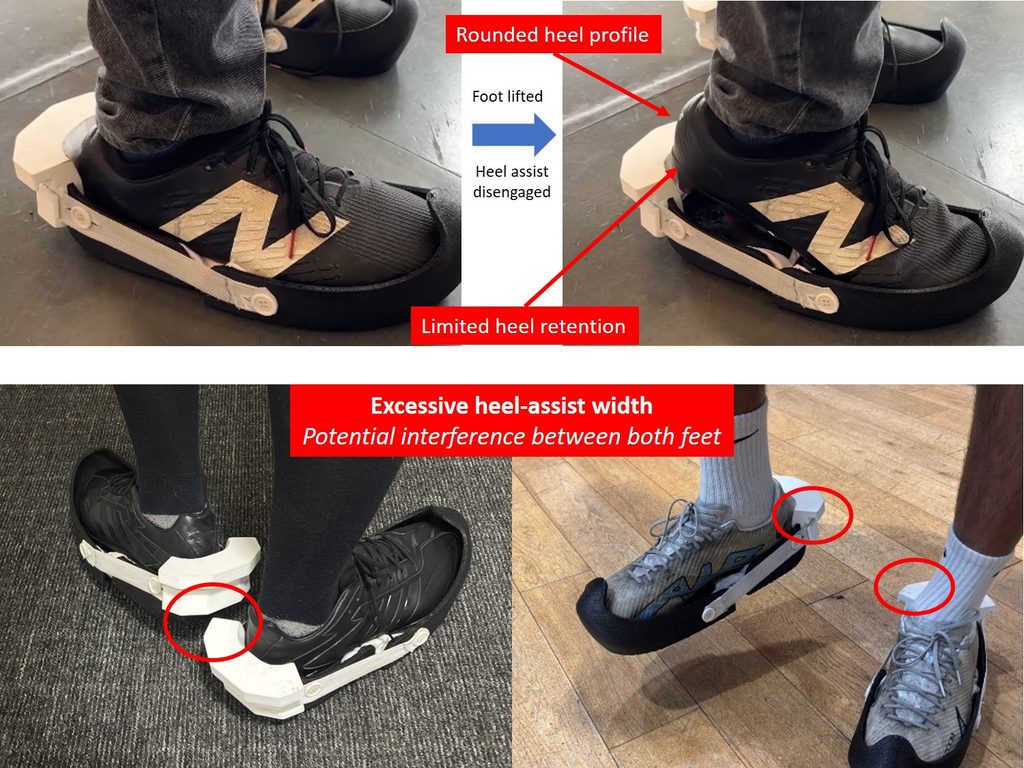
Rounded football studs were less securely retained by the heel assist, while its width could interfere with the opposite foot during walking. These findings directly informed the final design: the heel assist was narrowed to reduce interference and extended upwards with a rounded retaining profile to improve heel support and guide hands-free entry and removal.
User testing evaluated hands-free interaction, fit, dirt containment and cleaning with real sports footwear.
Testing identified insufficient heel retention with rounded profile and interference caused by the width of the heel assist.
The heel assist was narrowed and reshaped with a higher rounded retaining profile to improve stability and reduce interference.
Final Design
The final design brings the developed features together into a refined two-part footwear protection system for rapid, hands-free indoor/outdoor transitions. Flexible front and rear TPU shells protect key cleat zones, while EVA cushioning isolates studs from indoor surfaces.
An elastic textile connection adapts to different footwear lengths and contains debris, while detachable snap fasteners allow the system to be disassembled for cleaning and maintenance. The refined heel assist improves retention and guides the foot during hands-free donning and removal.
The final two-part system combines protective, cushioning and flexible components within a compact footwear-mounted design.
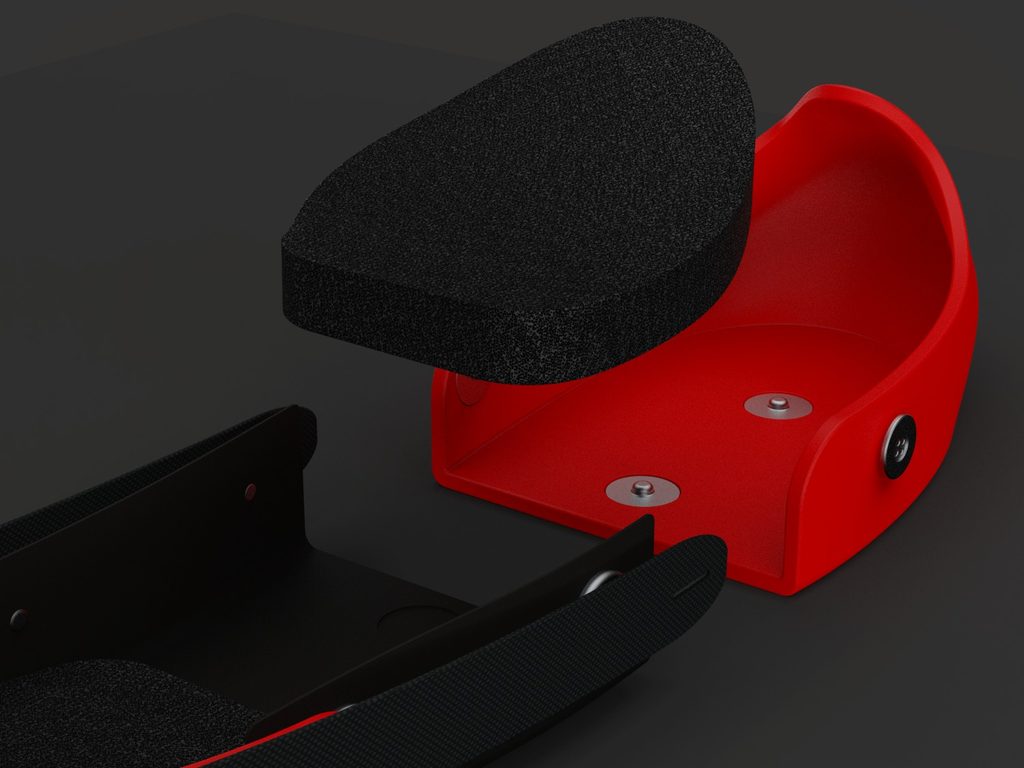
Exploded view of the modular two-part system, combining TPU shells, EVA cushioning, elastic textile connections and snap fasteners to protect cleats and indoor surfaces.
Detachable EVA cushioning pads connect to the TPU shells through snap fasteners, allowing individual components to be removed for cleaning or replacement.
User testing informed a narrower, integrated heel assist, improving shoe retention, reducing interference between the feet and supporting hands-free removal.
GoGo Goggles— AR Lifeguard Assistance System
GOGO GOGGLES is an augmented reality wearable concept designed to support coastal lifeguards in challenging rescue environments. The system integrates AR rescue navigation, obstacle detection and real-time environmental information into water-resistant goggles, helping lifeguards locate casualties and maintain situational awareness during rescue operations.
The goggles are integrated with a hydrodynamic helmet and functional features including communication, physical controls, underwater recording and headlights for low-light conditions. Through user and environment research, sketch ideation, interface development and CAD visualisation, the project explores how AR technology can be integrated into specialised rescue equipment to enhance visibility, information accessibility and operational efficiency in maritime rescue scenarios.
Adaptive Paraclimbing Assist & Harness System
Adaptive Paraclimbing Assist & Harness System is an inclusive sports design project developed to reduce participation barriers for beginner para-climbers with AL1 lower-limb paralysis. The system combines a supportive harness, lower-limb protection and an adjustable counterweight mechanism to improve stability, protect the user and reduce reliance on upper-body strength.
Developed as a team project, the proposal integrates inclusive product design with considerations of manufacturing, cost, distribution and implementation within climbing facilities. The project explores how adaptive equipment and a viable business strategy can work together to make climbing more accessible and sustainable. It received the Bronze Award in the Inclusive Sports Design Competition 2025–2026.